Halfway Up the Pipe: What Early Stewardship Left Master Data Management
Weaving Intelligence (House AI Style), with Jeff Shabel’s Experiential Commentary
Data stewardship, in my experience, did not start as a role anyone designed. It started with power users in the groups that an upstream error hurt, correcting records in their own systems that had gone wrong somewhere before them. Auditors flagged the problems, and fixing them became those groups' job. IT was brought in when the users said the work had outgrown them and was eating the time their real job needed. Since then the responsibility has moved around with the business, the regulators and the technology, and the current move is an attempt to hand it to AI. I told that history in full in Who Owns the Data, Really? Whoever the Error Hurt. Its one-line verdict is the part that matters: the business reacted rather than planned, gave the fix to whoever the damage landed on, and when that group ran out of knowledge or hours, pushed it back up the pipe.
This piece asks the next question. What from that start is still built into how master data programmes set up stewardship today, and should it be?
Two habits are the obvious candidates. One is the downstream fix: a steward correcting a record after it arrives, when the error was made somewhere earlier. The other is the part-time steward: stewardship as a duty added to a job that already has a name. I was asked which of the two I would design out first in a new programme, and what I would put in its place. I designed out neither, at least not as they were put to me. The part-time steward I would keep and make workable. The downstream fix has already moved halfway up the pipe, and the half it has not travelled is the problem.
Some terms first. Master data is the shared reference data the enterprise's systems pass between them: customers, products, suppliers, locations. A master data management (MDM) programme collects it from the systems that create it, matches and cleans it, and holds a governed version, usually called the golden record, in a layer of its own. A source system is the application where a record is first entered or changed: the order system, the customer relationship system, the supplier portal. A data steward is whoever is responsible for keeping a set of records right: deciding what a value should be, correcting it, and answering for it.
Where the two habits came from
Both habits are older than the frameworks that later tried to replace them, and both followed from the way stewardship began.
The part-time steward came first because the first stewards were not stewards. They were people with other jobs who found errors in the data they used and fixed them, because nobody else would. That is still the usual shape of the role. A Marketing Week feature on stewardship put it plainly: stewardship "is only rarely a standalone job," and "most stewards take on the ownership of a data item alongside their main role" [2]. The frameworks that arrived later designed accountability in advance, with councils, owners and named stewards, and Who Owns the Data, Really? sets several of them side by side. In many of the programmes I have seen, the designs changed the titles more than the work: the stewardship was expected to fit on top of the jobs people already had.
Robert Seiner, who calls his approach non-invasive data governance, has argued for years against the alternative. He contrasts it with common practice, where "most programs assign or hire people to be data stewards," and starts instead from the observation that "every person in your organization has a relationship to the data" [1]. His conclusion, "Everybody is a Data Steward" [1], is deliberately provocative, but the mechanism behind it is the useful part: "Formalizing this accountability does not involve assigning roles; rather it involves recognizing people into roles" [3]. On that view the part-time steward is not a compromise. It is the design.
The downstream fix also came from the start. The people who found the error were downstream of the system that made it, so the fix happened where they were: in their spreadsheet, their report, their copy of the record. Master data programmes, when they arrived, gave those corrections somewhere central to move to.
What follows is my own record, offered as a pattern I have watched repeat rather than as a law.
Keep the part-time steward; streamline the job
Asked which of the two habits I would design out first, I started with the part-time steward and declined the premise:
There are very few businesses and Enterprises that have enough volume to warrant dedicated Data Stewards. Business and Subject Matter Experts should have the responsibility of Data Stewardship for their data. Trying to hire and staff dedicated Data Stewards often introduces more issues in the process than streamlining the process such that it can be completed as a portion of an existing role.
The first sentence is a judgement about volume. A dedicated steward is a full-time position, and it makes sense only where the work fills a full-time week: enough records, changing often enough, with enough exceptions that need a person to resolve them. My judgement is that few organisations reach that point. I put no number on it; the test is the queue, not the headcount plan. Where the work does not fill the week, a full-time hire either sits idle between bursts or drifts to other work, and the stewardship drifts with them.
The second sentence is about who knows the data. The people who can tell whether a customer's classification is right, whether a supplier is really the same company as another, or whether a product hierarchy reflects how the business sells, are the people who use that data to do their jobs. That fits the rule for ownership I set out in Two Models and a Seam, that the owner is whoever the errors hurt: the person who suffers from a wrong value is usually the person best placed to say what the right one is. Stewardship assigned to them follows the knowledge. Stewardship assigned to someone hired for it has to borrow the knowledge, a question at a time, from the people who already have it.
The third sentence carries the remedy, and it is the one programmes skip. I did not say that adding stewardship to a job works. I said that streamlining the process until it fits inside a portion of an existing role works better than staffing around it. Those are different claims, and I have been on record against the first. I have called it a constant problem when stewardship is part of someone's responsibility rather than the whole of it, and I have described programmes that expected the running cost of stewardship to be absorbed by existing staff, on top of what they already did; both are quoted in Who Owns the Data, Really?, and I stand by both. They describe the same failure this answer avoids. What fails is the add-on: stewardship bolted onto a job unchanged, with the same tools, the same queues and the same unbounded list of things to check, and no time or budget set aside for it. The remedy is not to take the work away from the people who know the data. It is to change the work until it fits. A streamlined stewardship process sends a person only the decisions that need them, with the context they need to decide, in a volume a portion of a week can absorb.
The mechanics are not exotic. In The Queue Nobody Worked I described rebuilding unworked stewardship around positions rather than named people, with daily digests, ageing, service levels and escalation tied to the role. Those are the tools of streamlining: the work goes to a role, its age is visible, and its escalation does not depend on anyone remembering. In Heads Up I forecast that the steward may become one aspect of another position rather than a position of its own; if that happens, those tools are what will make the aspect workable.
My answer did not list the issues that hiring dedicated stewards introduces. The history suggests one, and I offer it as a reading rather than a record. A newly hired steward team is a new group to push the fix to. The pattern in that history was to hand the problem to whoever could be made to hold it, and a dedicated team that sits between the people who make the data and the people who use it is a very convenient place to hold it. The source system keeps producing the error, the users keep finding it, and the steward team keeps correcting it, every day, in the middle.
The case for dedicated stewards deserves its strongest form, because it is a common view. A 2026 guide to stewardship for MDM programmes lists "stewardship as a side job (gets squeezed out)" among the common ways programmes fail, alongside "too few stewards for the data volume (burnout)," and concludes: "Build stewardship as a real function, not a hat someone wears" [5]. William McKnight, quoted in a TechTarget feature on stewardship programmes, described the same failure from the other side: "People get busy with their own deliverables and don't follow through with data stewardship" [4]. And a 2018 DATAVERSITY survey report found that only about one-quarter of its respondents agreed that everyone in their organisation, business and technical, takes their part in stewardship seriously; the report does not state its sample size, so I would treat that as a signal rather than a measurement [6]. One of the report's respondents predicted exactly the pattern I am defending, as a complaint: "Leaders will not allocate full-time positions, but rather add another role for existing employees to fill" [6].
Two of those points I accept outright. Where the volume is real, the guide is right that too few stewards burn out, and a dedicated steward is warranted; my answer said very few organisations reach that volume, not that none do. And stewardship that loses to the day job is the failure I have described myself. Where I part company is on the inference. That a side job gets squeezed out is an argument for making the side job smaller and clearer, with time set aside for it. It is not, on its own, an argument for moving the work to people who know less about the data. None of the sources argues that a dedicated team gets better data than streamlined stewardship by the people who use it; they argue that unstreamlined stewardship by those people fails, and on that we agree.
The fix moved up the pipe, and stopped
The downstream fix has a different history. It did not stay where it started. It moved, and on the whole it moved in the right direction. The second half of my answer was about where it stopped:
Downstream transformation and cleansing moving up into the Master Data Layer is, generally, a good thing, but, unfortunately, it often stops there and the loop is never closed. Entirely too many MDM systems do not have any feedback mechanism to push changes back to the source systems, so they’re being asked to incorporate ‘permanent’ data fixes into their pipelines.
Moving a correction out of a report and into the master data layer is progress, and it is worth saying why before saying what is wrong with it. A correction in a report fixes that report. The next report built on the same source carries the same error until someone finds it again and fixes it again, usually a little differently. A correction in the master data layer fixes the value once, and every system and report downstream of the layer gets the corrected value. One fix replaces many, and the many stop disagreeing with each other.
But I hold that a fix belongs at the source, in the system that provides the data or, for a calculated value, in the step that calculates it, and that anything downstream of that is a patch, not a fix. I made that argument in Two Models and a Seam, and The Same Fight applied it to policy that the systems enforce themselves. The master data layer is downstream of the source. A correction held there is still a patch: a better-placed patch, one patch instead of many, but a patch. The source system keeps producing the defect, the master data layer keeps correcting it, and nothing tells the people who run the source that their system is wrong. The fix has moved halfway up the pipe and stopped.
Why it stops there is not a mystery, and much of the reason is designed in at the start. A disclosure first, because the next few paragraphs lean on vendors' accounts of the category. The practice behind this publication is a Profisee partner: clients pay us for deployment work, a licence sale we refer earns us a referral fee, and our services revenue depends on master data management software being bought at all. That interest runs toward the category and toward Profisee, so weigh anything favourable I say about either below my criticism of them.
The common descriptions of how an MDM programme can be built name four implementation styles, and two of them do not send corrected data back to the sources at all. Profisee's own guide is explicit. In the consolidation style the MDM platform "acts as a hub" and is the system of record for consolidated data, and "Data is not synced back to source systems"; the registry style "Doesn't update master data in source systems, forgoing data accuracy in source systems." Only in the coexistence and centralised styles does corrected data reach the systems where it is used: in coexistence, "Data consolidated in the MDM platform syncs back to source systems," and in the centralised style data mastered on the platform "is then distributed to operational systems" [7]. A programme built in either of the first two styles has, by design, no route back.
Programmes often start there, and for reasons that are hard to argue with. Another Profisee article describes the analytical starting point as one where "data flows are almost always one-way," and calls it a logical starting point for being "non-disruptive to current business processes and data flows," with "time-to-value, minimal organizational disruption, and lower complexity/risk than operational MDM" [9]. The cost of the next step is stated just as plainly: "almost all operational use cases will require changes to business processes" [9]. Closing the loop means changing how the source system is run, and that means persuading the people who run it. A first phase that avoids that conversation is easier to sell and faster to deliver. Dalton Cervo, quoted by Phil Simon on The Data Roundtable blog, named what is lost when it never happens: "organizations fail to harvest the benefits of the MDM services back to their operational data" [8].
That is the halfway point. The early stewards fixed data where the error hurt them. The master data programme collected those fixes into one place, which was the right move. And then, too often in my experience, it went no further. A likely reason, which I offer as a reading rather than a record, is that the next step needs the source system's owners to change something, and that is the conversation easiest to leave for a later phase.
Asked afterwards whether the gap was in the software or in how it is built, I was specific:
Implementations. The systems support and are designed to have feedback mechanisms. However, many--in my experience, most--systems don’t implement them. Further, in a lot of cases, despite the capacity being there, the source systems are publicly available data or purchased data products that are sold to the Enterprise--think subscriptions to Law Articles, Real Estate Transactions, Regulatory Updates, etc. In those cases there’s functionally no way to send Enterprise-specific updates to the source system because the source is a pure publication with multiple consumers.
The first half of that answer puts the problem where it belongs. The platforms can close the loop; most implementations, in my experience, do not build the route. That is a decision a programme makes, often by default, and it can be revisited. The second half is the harder case, and the section on closing the loop comes back to it: some sources are not systems anyone in the enterprise runs.
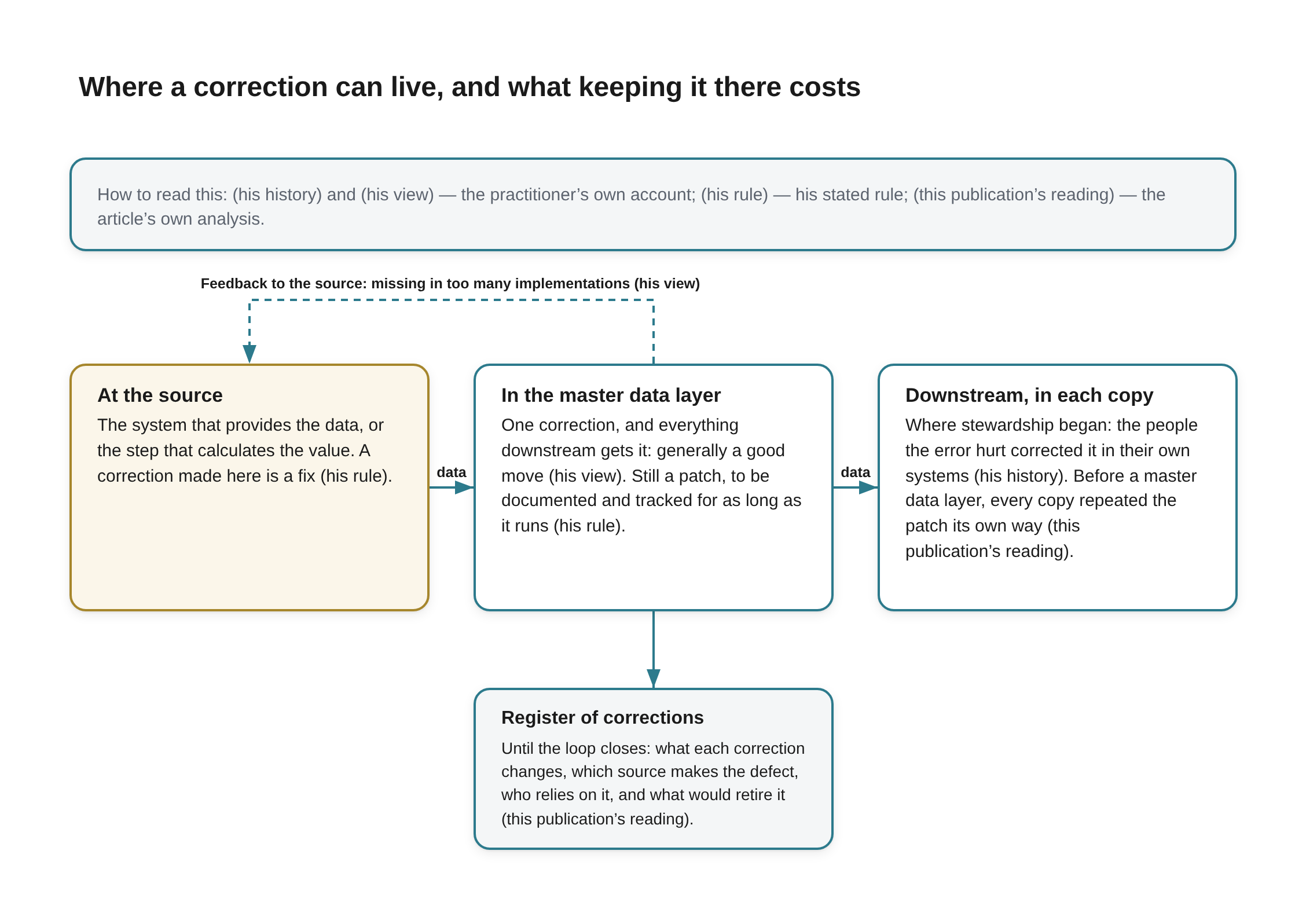
Where a correction can live, and what keeping it there costs Beneath the title a key reads: How to read this: (his history) and (his view) — the practitioner’s own account; (his rule) — his stated rule; (this publication’s reading) — the article’s own analysis.
Three boxes in a row, joined left to right by arrows labelled data. On the left, outlined in amber, At the source: The system that provides the data, or the step that calculates the value. A correction made here is a fix (his rule). In the middle, In the master data layer: One correction, and everything downstream gets it: generally a good move (his view). Still a patch, to be documented and tracked for as long as it runs (his rule). On the right, Downstream, in each copy: Where stewardship began: the people the error hurt corrected it in their own systems (his history). Before a master data layer, every copy repeated the patch its own way (this publication’s reading).
A dashed arrow runs from the top of the master data layer back over to the top of the source, labelled: Feedback to the source: missing in too many implementations (his view).
A solid arrow runs down from the master data layer to a grey box, Register of corrections: Until the loop closes: what each correction changes, which source makes the defect, who relies on it, and what would retire it (this publication’s reading).
What a "permanent" fix costs
A correction the source never receives does not go away. It becomes a rule in the master data layer's pipeline, applied every time the defective value arrives, for as long as the source keeps sending it. Asked what that costs, I answered with the two jobs such a rule creates:
These fixes need to be documented and tracked so that a) they can be explained to downstream users of the data when questions arise about the source of the data and b) changed when the business requires something different. Both of which require additional overhead and maintenance that would be obviated if the issues could be addressed at the source.
Both reasons are about questions that arrive later, from people who were not there when the fix was made. The first comes from downstream. A user notices that the value in the report is not the value in the source system and asks which one is right, and why they differ. If the correction is written down, with what it changes and why, the answer takes minutes. If it is buried in pipeline logic that one developer wrote three years ago, the answer takes days, and it may come back as "we are not sure." The second comes from the business. The rule that turns one code into another was right when it was written; then the business reorganises, or a regulation changes, or the source system is upgraded and starts sending the value correctly, and the rule now corrects something that is no longer wrong. A rule nobody can find cannot be changed when it should be.
The banking supervisors arrived at much the same requirement for a narrower kind of data. The Basel Committee's principles for risk data aggregation, published in 2013 and known as BCBS 239, expect banks "to document and explain all of their risk data aggregation processes," "whether automated or manual (judgement based or otherwise)," and say the documentation "should include an explanation of the appropriateness of any manual workarounds," with "a description of their criticality to the accuracy of risk data aggregation and proposed actions to reduce the impact" [10]. The scope is banks' risk data, not master data in general, and I would not stretch it further than that. But it is a regulator requiring in writing what my answer required, that a workaround be documented and explainable, and going one step further: its importance has to be stated and actions proposed to reduce its impact.
The last part of that requirement, actions to reduce the impact, is the one most programmes leave out. Documenting a permanent fix makes it explainable. It does not make it any less of a cost. Larry English, who spent his career on information quality, put the economics bluntly: "Data correction is also a cost item caused by allowing the status quo process to continue to produce defective information," and "every dollar you spend on Data Correction (Information Scrap and Rework) is waste" [11]. The idea is older than data management. W. Edwards Deming's third point for management told manufacturers to "cease dependence on inspection to achieve quality" and to "eliminate the need for inspection on a mass basis by building quality into the product in the first place" [12]. A correction rule in the master data layer is inspection on a mass basis. It works, and it is paid for again on every load.
That is the argument for closing the loop in one sentence: the documentation and the maintenance are overhead that exists only because the source was never fixed, and the overhead grows with every correction the source never hears about. Until the loop closes, the least a programme owes its users is a register of those corrections, kept where both of my two questions can be answered from it.
Closing the loop without breaking the source
Closing the loop does not mean pushing the master data layer's version into every source system, and the strongest objection to my answer comes from people who have watched that go wrong. Profisee's vice president of education warns that "Directly pushing golden records into systems like CRMs can cause data duplication and confusion," and recommends a narrower route for operational programmes: "update existing records with the best attribute values from the golden record" [13]. A source system that receives records it did not create, in a structure it was not designed for, can end up worse than before. And some sources cannot be changed at all by the organisation that consumes them. Many of them, in my experience, are not systems anyone in the enterprise runs but publications: public data, and purchased data products such as subscriptions to legal articles, real estate transactions or regulatory updates, published or sold to many consumers at once and with no way to take one enterprise's correction. A packaged application whose owner will not accept the change, or a regulated record that may not be overwritten after the fact, is a case of the same kind.
I accept all of that, and none of it changes the answer. What I said was missing is a feedback mechanism to the sources. I read that as a route back, not necessarily an automatic overwrite, and a route back can take several forms, and the right one depends on the source. Where the source can safely accept the corrected value, the coexistence pattern sends it back, attribute by attribute, into the existing record. Where it cannot, the loop can still close through people: the defect is reported to whoever owns the source, with the evidence, and the fix is made there, in the source's own process, by the people who run it. And where the source genuinely cannot be fixed, the correction is permanent in fact, not just in name, and the register of corrections is where that is written down, so that nobody mistakes a standing workaround for a solved problem.
The rest of the data field has been moving the same way, from the other direction. The data mesh approach, which Zhamak Dehghani set out on Martin Fowler's site, holds that "the accountability of data quality shifts upstream as close to the source of the data as possible" [15]. The data contract movement describes "shifting left," which Andrew Jones defines as "addressing data quality, structure, and governance at the point of creation"; in his words, "you prevent them at the source—where data is created" [14]. Neither of them is writing about master data management, and a strict reading of the mesh view would object to the master data layer correcting other domains' data at all. I think that objection and my answer point the same way. Seen from a downstream report, the master data layer is upstream, and moving a fix into it is moving toward the source. Seen from the source, it is still downstream, and the mesh is right that the work is not finished. My complaint is the same as its complaint. The fix stopped halfway.
What would show this is wrong
Both halves of the argument can be put narrowly enough to fail.
The first claim is that, at the volume most organisations have, streamlined stewardship by the people who use the data does better than a dedicated steward team. Evidence against it would be a comparison showing that dedicated teams, at ordinary volume, produce more accurate master data or resolve issues faster than embedded stewards with a streamlined process. This article's search of practitioner guides, trade features and the one survey report above found no such comparison in either direction. The sources that favour dedicated stewards argue from the failure of the add-on, which I share, rather than from a measured comparison; that absence is scoped to what was searched. What the search did find cuts partly against me: if only about a quarter of respondents in one survey think everyone takes their part in stewardship seriously, then stewardship spread across the business has a poor record by default [6]. That narrows the claim rather than overturning it. Embedded stewardship works only when the process is streamlined and the time is real. The narrower rule still rules something out: it says that hiring a dedicated team should not be the first response at ordinary volume, and that a programme which does so has staffed around a process it should have fixed.
The second claim is that, for the sources the enterprise runs, a correction held in the master data layer without a route back to the source costs more over time than the work of closing the loop. Evidence against it would be a programme that holds its corrections centrally for years at a stable, low maintenance cost, while the attempt to change the sources costs more than it saves. This article's search found no study measuring either side. The sources describe the cost of changing business processes [9] and the risk of writing back carelessly [13], and both are real. Neither describes a central correction layer whose cost stays flat, and the requirement to document and explain every manual workaround and propose actions to reduce its impact [10] treats a workaround's impact as something to be reduced, not left as it is.
The third possibility is that the loop cannot be closed for most sources, which would make my answer true and useless. Some sources cannot be changed, as above. But the implementation styles exist because many can, and a programme that has not tried to close the loop for any of its sources has not found out which ones those are.
What I would set up on day one
For a new programme, the two answers together suggest a short set of commitments, stated here as recommendations rather than as a record.
Assign stewardship to the people who use the data, by domain, and write the work into their roles as a bounded portion with time set aside for it. Streamline before you staff: route each person only the decisions that need them, with the context to decide, and track ageing and escalation by position rather than by name. Hire a dedicated steward only where a domain's volume has shown it can fill the week, and expect to show that with the queue, not to assume it.
Treat every correction in the master data layer as a patch from the day it is written, and give it an entry in a register: what it changes, which source produces the defect, who downstream relies on it, and what would let it be retired. The register answers the user's question and the business's change request, the two reasons in my answer, and it also answers a third question nobody else is asking: whether the loop is closing. A register that shrinks means sources are being fixed. A register that only grows means the programme has become the source system's permanent cleanup crew.
Build a route back to the sources from the first phase, even if the first phase is a consolidation hub. It does not have to be an automated write-back on the first day. It does have to exist: a named owner for each source, a way to send them the defect with the evidence, and a date by which someone will ask whether it was fixed. And it needs a consequence: a register entry that ages past an agreed limit escalates, by position, to whoever is accountable for that source system, using the same ageing and escalation the stewardship queue already runs on.
None of this changes with AI, which is the latest place the business has tried to send the work. A model that corrects records downstream can be a faster and more consistent patch, which is useful. In Same Work, New Tools I argued that the rules engines of the pre-AI era mostly kept their promise and still left the steward's loop unchanged; a model that corrects records is in the same position. It is still downstream of the source. If it also tells the source what it found, it is part of the loop. If it does not, it is the same patch, applied at greater speed.
Halfway up the pipe
The question was which inherited habit to design out first. My answer was that neither is the thing to design out as it was put to me: the part-time steward needs streamlining, not replacing, and the downstream fix has already moved halfway up the pipe. The part-time steward was the right instinct from the start: the people the error hurts know the data best, and stewardship belongs with them. What failed was the job wrapped around them, unbounded and unfunded, and the remedy is to streamline it, not to hand it to someone else. The downstream fix was the wrong place to correct data, and the industry has already moved most of it up into the master data layer, which was the right move as far as it went. What failed was stopping there.
Early stewardship pushed the problem back up the pipe because the people it landed on could not hold it. Modern master data programmes pushed the fix up the pipe because a central layer could hold it. The second is better than the first. But the pipe has a top, and the error is made there. Until the fix gets there too, every correction the programme makes is one it will be making again tomorrow, and documenting each time why.
References
[1] Robert S. Seiner, "It's all in the Data: Everybody is a Data Steward (Get Over It)," TDAN.com, undated. Read in full 2026-11-05. https://tdan.com/?p=20003
[2] David Reed, "Keepers of the truth," Marketing Week, undated. Read in full 2026-11-05. https://www.marketingweek.com/keepers-of-the-truth/
[3] Robert S. Seiner, "Democratizing Data Stewardship," Solutions Review, undated (page copyright 2024). Read in full 2026-11-05. https://solutionsreview.com/thought-leaders/democratizing-data-stewardship
[4] Beth Stackpole, "Successful data stewardship framework needs solid plan, firm focus," TechTarget, 31 October 2012. Read in full 2026-11-05. https://www.techtarget.com/data-technologies/feature/Successful-data-stewardship-framework-needs-solid-plan-firm-focus
[5] Sharjeel Hashmi, "How to Build a Data Stewardship Program for MDM Success," Centric, 6 July 2026. Read in full 2026-11-05. https://www.centricdxb.com/insights/data-stewardship-program-mdm
[6] Anthony Algmin and Jennifer Zaino, "Trends in Data Governance and Data Stewardship: A 2018 DATAVERSITY Report," DATAVERSITY, 2018. Read in full 2026-11-05; the report does not state its sample size. https://content.dataversity.net/rs/656-WMW-918/images/Trends%20in%20Data%20Governance%20and%20Stewardship_FinalRP-Graphs.pdf
[7] Benjamin Bourgeois, "Master Data Management (MDM) Implementation Styles, Explained," Profisee, 12 February 2024. Read in full 2026-11-05. https://profisee.com/blog/master-data-management-implementation-styles/
[8] Phil Simon, "Operational vs. analytical MDM," The Data Roundtable, 2 May 2017, quoting Dalton Cervo. Read in full 2026-11-05. https://blogs.sas.com/content/datamanagement/2017/05/02/operational-vs-analytical-mdm/
[9] Christopher Dwight, "How to Expand from Analytical to Operational MDM [3 Key Considerations]," Profisee, 15 April 2024. Read in full 2026-11-05. https://profisee.com/blog/how-to-expand-from-analytical-to-operational-mdm-3-key-considerations/
[10] Basel Committee on Banking Supervision, "Principles for effective risk data aggregation and risk reporting" (BCBS 239), Bank for International Settlements, 9 January 2013. Read 2026-11-05 (Principle 3 and paragraphs 36–40). https://www.bis.org/publications/201301-guidelines-principles-effective-risk-data-aggregation-and-risk-reporting.pdf
[11] Larry English, interview, "Information Quality Applied," Data Quality Pro, undated. Read in full 2026-11-05. https://www.dataqualitypro.com/larry-english-information-quality-applied-interview/
[12] W. Edwards Deming, Out of the Crisis (Cambridge University Press, 1982 and 1986), point 3 of the fourteen points, as given by the University of Cambridge Institute for Manufacturing, "Deming's 14 points," undated. The page was read 2026-11-05; the book was not. https://www.ifm.eng.cam.ac.uk/research/dstools/demings-14-points/
[13] Lee Gregory, "When Should You Publish Golden Records?," Profisee, 21 April 2025. Read in full 2026-11-05. https://profisee.com/blog/when-to-publish-golden-records
[14] Andrew Jones, "Shifting Left: How Data Contracts Underpin People, Processes, and Technology," Confluent, 2 April 2025. Read in full 2026-11-05. https://www.confluent.io/es-mx/blog/shifting-left/
[15] Zhamak Dehghani, "Data Mesh Principles and Logical Architecture," martinfowler.com, 3 December 2020. Read in full 2026-11-05. https://martinfowler.com/articles/data-mesh-principles.html