Fix First, Find Last
Weaving Intelligence (House AI Style), with Jeff Shabel’s Experiential Commentary
The question I was asked this week came with an order already in it. If you were standing up a model against data quality at scale, which of the three jobs would you give it first, detecting the problems, diagnosing them or remediating them, and which last? The question's own example of diagnosis was a profile that finds the blanks in one column jumping between two loads, and a model asked what probably caused it. Writing the fix back into the records was set aside for another week. The order most people would expect is the order of the words: find the problem, work out why, then fix it. My answer turned it upside down:
I would task it first with Remediating errors detected by programmatic validation. This would likely involve implicit diagnosis, but—and this ties into your question on what to give it—the ‘diagnosis’ would likely be what tripped the automatic validation.
So the first job is next door to the one the question had set aside: a fix proposed for a record still held in the import, not one written into the master. And the model does not find anything. Something else has already found it: the validation a pipeline runs on every load, the type checks, the required fields, the allowed values, the rules the business has written down. Those are cheap, they are exact, and they are old. What they are bad at is the next step. A rule can say that a postcode is missing, that a country code is not in the reference table or that a date of birth falls after the date of hire. It cannot say what the value should have been. That is the gap a model fills, and it is a much smaller gap than "data quality".
The diagnosis comes with the error. A record that fails the rule that every supplier needs a country has a known defect, in a known field, against a known rule, before any model is called. What is left to work out is the correct value and whether one can be found at all, and that is remediation. Diagnosing a record is the first half of fixing it, which is why I folded the one into the other rather than giving them separate places in the order.
I have designed systems this way, and I am building one now. What follows is the design and the reasons for it, not results, because the one being built has none to report yet.
A disclosure: the practice behind this publication is a Profisee partner; clients pay us for deployment work, a licence sale we refer earns us a referral fee, and our services revenue depends on master data software, AI features included, being bought. That interest runs toward the category, so weigh anything favourable I say about it below my criticism of it. It runs against the two data observability vendors I describe next, Monte Carlo and Anomalo, which sell to the same data quality budget, so discount my criticism of them.
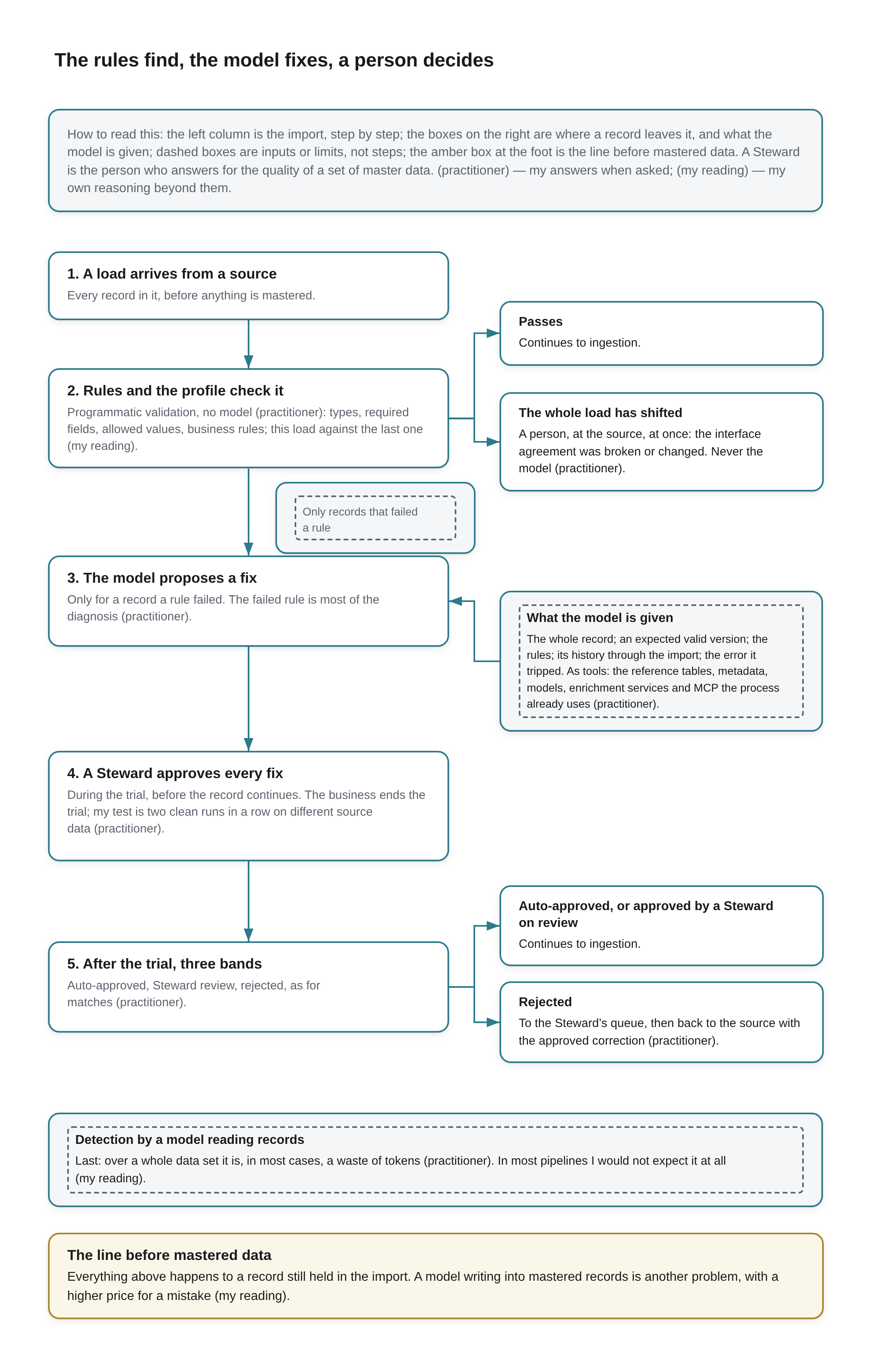
The rules find, the model fixes, a person decides Beneath the title a key reads: How to read this: the left column is the import, step by step; the boxes on the right are where a record leaves it, and what the model is given; dashed boxes are inputs or limits, not steps; the amber box at the foot is the line before mastered data. A Steward is the person who answers for the quality of a set of master data. (practitioner) — my answers when asked; (my reading) — my own reasoning beyond them.
Five steps stacked from top to bottom in the left column, joined by downward arrows. Boxes to the right show where a record leaves the import and what the model is given.
- 1. A load arrives from a source. Every record in it, before anything is mastered.
- 2. Rules and the profile check it. Programmatic validation, no model (practitioner): types, required fields, allowed values, business rules; this load against the last one (my reading).
- 3. The model proposes a fix. Only for a record a rule failed. The failed rule is most of the diagnosis (practitioner).
- 4. A Steward approves every fix. During the trial, before the record continues. The business ends the trial; my test is two clean runs in a row on different source data (practitioner).
- 5. After the trial, three bands. Auto-approved, Steward review, rejected, as for matches (practitioner).
From step 2, arrows lead to two boxes on the right. Passes: Continues to ingestion. The whole load has shifted: A person, at the source, at once: the interface agreement was broken or changed. Never the model (practitioner).
A dashed box beside step 3, with an arrow into it, headed What the model is given: The whole record; an expected valid version; the rules; its history through the import; the error it tripped. As tools: the reference tables, metadata, models, enrichment services and MCP the process already uses (practitioner).
Between steps 2 and 3, beside the arrow, a dashed box reads: Only records that failed a rule.
From step 5, arrows lead right to two boxes. Auto-approved, or approved by a Steward on review: Continues to ingestion. Rejected: To the Steward’s queue, then back to the source with the approved correction (practitioner).
Below the steps a dashed box headed Detection by a model reading records: Last: over a whole data set it is, in most cases, a waste of tokens (practitioner). In most pipelines I would not expect it at all (my reading).
At the foot, a full-width box outlined in amber, headed The line before mastered data: Everything above happens to a record still held in the import. A model writing into mastered records is another problem, with a higher price for a mistake (my reading).
Why finding comes last
The ordering is easiest to defend from the bottom, so I will start with the job I put last:
Surprisingly, I would give the ‘detect’ job last because it is likely to be applied to the entire source data set and I consider that to, in most cases, be overkill and a general waste of tokens. Diagnose is already included in remediation, since one can’t really remediate without having identified the problem (Diagnosis).
"Surprisingly" was my word, and my reading of it is that I expected the reader to expect detection first. Detection is where the data observability products have built their businesses [1][2], and it is the job that sounds most like what a model is for: look at everything, notice what is odd.
The objection is the arithmetic of "everything". A rule runs over every record in a load for almost nothing; that is what rules are for. A model called per record is priced per token, and the bill scales with the size of the load, not with the number of problems in it. A load of ten million records costs the same to search with a model whether a few thousand of them are wrong or none are.
The arithmetic that follows is mine, from one provider's published prices on the day I wrote this [3]. Send each of ten million records with its rules and instructions, call it 1,500 tokens in and 200 out, and one pass through a mid-tier model costs about $50,000 at list price, or about $25,000 through the provider's batch service, which halves the rate. Through the same provider's smallest current model in batch, it is nearer $1,250. These figures are ceilings: most of the 1,500 tokens in are the same rules and instructions on every call, and on the mid-tier model prompt caching cuts the price of those by about 95 percent, though not of the output, so a cached pass costs roughly half the list figure. The smallest figure is not ruinous, and I will not pretend it is.
Nor will I pretend a model cannot find errors: on two benchmark datasets, GPT-3 shown ten examples of the task detected errors as well as or better than a detector built for the job [4], on about a thousand rows each, with the ten examples picked by hand. The case against detection by model does not rest on one pass. It rests on the pass being repeated for every load, forever, against data that is mostly clean, with every record the model finds odd then needing someone to look at it. Researchers building a language-model error detector, ZeroED, make the same complaint about their own field: approaches of this kind must read every tuple in the dataset, and the token cost of doing so on large datasets is, in their words, "extremely high" [5]. Their answer was to send the model only a sample chosen by clustering and to train a cheap classifier on what it labelled to check the rest. The same per-token price applies to the remediation I put first, and each of those calls carries far more: the record, an exemplar, the rules, the history and its tool calls. It costs less in total only because just the records a rule failed ever reach it, which is the point.
I have made the general argument before, that there is no reason to send every record through a model and that doing so attaches a cost to every record the pipeline will ever ingest, including the ones it has already seen (Putty, Not Body Panels). I have also watched an organisation I worked with put AI into everything in its pipelines, run through its budget almost at once, and then cut its AI use to the bone, which is the opposite mistake and no better.
The strongest objection to my order is that a large and serious part of the industry does put machine learning on detection first, and does it at scale without going broke. Monte Carlo deploys machine-learning monitors across a customer's production tables by default, watching freshness, volume and changes of schema without anyone setting a threshold [1]. Anomalo argues that rules cannot anticipate everything that will go wrong, and trains a model on a sample of rows to tell whether today's data looks like the days before it [2]. The research behind them is real. Google's description of its data validation for machine learning pipelines sets out schema checks and the detection of skew and drift between datasets [6], and a study of dataset shift on image benchmarks found that two-sample statistical tests, applied after reducing the data's dimensions, detect shift well [7]. If detection by machine learning is good and affordable, why put it last?
Because that is not what I was putting last. My objection was to tokens, and my rule about models has always been about calls to a hosted model priced by the token, not about the statistics or the trained matching a platform already runs as part of its processing. Monte Carlo describes its language-model agents reviewing data samples [8]; Anomalo describes using language models on document quality without saying how much they read [9]. Neither vendor's pages that I read describes sending each record to a language model. A monitor that learns when a table usually refreshes, or classifies a sample of rows, works on summaries and samples of a table rather than on all of its records, and its cost does not grow with a per-token price. It sits in the same place in my design as the profile and the rules: the deterministic, or at least statistical, layer that finds things. My reading is that a model that reads a sample, or teaches a cheap classifier that then reads everything, belongs in that layer by the same logic, and ZeroED [5] is an example of exactly that. My reading is that the observability vendors and I disagree less than the word "detection" suggests. What I put last is a language model called on every record to find what is wrong with it. What they put first is mostly arithmetic on tables and samples, and I would put that first too.
There is one more reason, and it has nothing to do with cost. A rule that fails says which rule failed. A model that flags a record as odd says that the record looked odd to it, and the next person has to work out whether that is a problem, which rule it breaks and whether the rule is right. Detection by rule produces a diagnosis as a side effect. Detection by a language model produces another thing to diagnose. The engineers behind Google's validation system put the human side of this plainly: the people on call learn to ignore alerts that are noisy or that they cannot act on, and important errors then go unnoticed [6]. An alert that names a rule can be acted on. An alert that names a feeling about a record is the kind people learn to ignore.
What the rule already knows
Separating detection from correction is not my invention. The research on cleaning data treats them as two problems with two different kinds of system. Mahdavi and colleagues built one system to detect erroneous values without configuration [10] and a separate one to correct them, which learns a correction from the value itself, from the other values in the same record and from the values in the same column across the data [11]. HoloClean, a repair system from 2017, takes the errors as found and works out the most probable repair from integrity constraints, matching against outside data and the statistics of the dataset [12]. In each case, finding the bad cell is one job and proposing what it should hold is another, and the second uses far more context than the first.
That second point is the one my answer turns on. Rules engines were my niche for over a decade before anyone called any of it AI, the profiling that proposes rules was among the automation I built beside them, and almost all of it delivered what it promised (Same Work, New Tools). It is the detector in this design, and it is good at the job. What it hands on is a record, a rule and an error: exactly the starting point a correction system needs and a detection system does not produce.
What the model is handed
If remediation goes first, the question's second half becomes what a model must be given to do it usefully. My answer was a list:
I would provide the AI the whole record that errored, the expected ‘valid’ version of a record, the associated rules that need to be applied to the record, the history of the changes (if any) to the record as part of the import process to that point, and, finally, the automatic validation error that it tripped. I would make available any relevant reference tables, MCP, models, metadata and enrichment services used in the process to that point as well, so the model would have those available as tools, skills and reference information.
Asked once which failure I keep seeing, I said it is a model given only the data set to go on: it works with complete confidence and no knowledge of anything outside it, so it will file car brands among tree species without noticing, because it does not know what either one is. The list exists because of that failure. A model is fluent and has no idea what it does not know. The only remedy I trust is to give it what it is missing, and every item on the list is something that, left out, lets it be confidently wrong in a particular way.
The whole record, not the failing field, because the correct value of one field is often visible in the others: the city and the postcode check each other, a currency follows from a country. The research on correction builds this in: Baran's corrections draw on the value itself, the other values in the same record and the other values in the same column, which its authors call domain information [11]. The expected valid version, which I read as a conformant example of the same kind of record, the target shape the record has to reach, because a model that has never seen a good supplier record will repair toward its own idea of one. The rules, because the model needs to know what will be checked again after it has finished. The record's history through the import so far, because a value that was right at the source and wrong after a transformation was broken by the pipeline, not the provider, and the fix belongs in a different place. And the error itself, so that the model starts from the defect the rule found and not from a fresh look at the whole record.
The tools are the other half. Reference tables, metadata, the models and enrichment services the process already uses, and MCP, the Model Context Protocol, an open standard Anthropic introduced in November 2024 for connecting a model to tools and data sources through one interface [13]. Profisee, for one, now lists an MCP server for connecting governed master data to AI agents [14]. My answer bounded them with seven words: the ones "used in the process to that point". The model does not reach for a new source because it seems helpful. It uses the services the pipeline already trusts, so that a correction it proposes can be traced to the same reference data the rule was checking against.
The published evidence is thinner than the pitch, and it points the same way. When Narayan and colleagues tested GPT-3 on error detection, it scored an F1 of 6.9 on a hospital dataset with no examples of the task and 97.8 with ten, ahead of the purpose-built detector they compared it with; on a census dataset the same move took it from 0.0 to 99.1, level with that detector [4]. The model did not change between those runs. What it was given did. The same authors warn that such models struggle with jargon rarely found in ordinary text and make unexpected errors, and a later study of GPT-4 on the same kinds of task notes that these models sometimes produce output that sounds plausible and is wrong [15]. A plausible wrong value is the worst kind for a data quality pipeline, because it passes the rule that caught the original.
Studies of model confidence give the other half of the warning. Xiong and colleagues found that language models, "when verbalizing their confidence, tend to be overconfident" [16]. A model's stated confidence in its own fix is therefore not a gate. Context makes the fix better; it does not make the model's opinion of its fix trustworthy. That is what the next step is for.
Who signs the fix
The question asked who checks the diagnosis before anyone acts on it. My answer had two stages:
Initially, I would have a Data Steward check/approve the diagnosis before the record was approved for continued ingestion. Once we’ve run it through a ‘trial period,’ I would treat its results in a similar way to those coming out of a Mastering Strategy—auto-approved, Steward/manual review, rejected.
The first stage is plain. Every fix the model proposes waits for a Data Steward before the record moves on, and the record does not move on until the steward has approved it. Most pipelines already decide what happens to a record that fails validation. Databricks, for one, lets a pipeline write it to the target anyway and count the failure, drop it, or stop the whole update, and documents a fourth pattern that sets invalid records aside without failing or dropping anything [17]. A record waiting for a steward's decision is that fourth pattern with a proposed fix attached. What the design adds is the rule that the record does not move until the decision is made.
The second stage borrows the shape every master data team already works with. A matching strategy sorts proposed matches into those it is confident enough to apply, those it sends to a steward, and those it rejects; Profisee's own description of matching keeps a person in the loop for the inconclusive middle [18]. I have described where those three outcomes come from and how the queue they produce should be worked (Another Set of Eyes). The same three bands apply to a model's fixes. The classification research has a name for the middle band, the reject option, and it was set out by Chow in 1970 as a trade between the errors a classifier makes and the decisions it declines to make [19]; later work treats it as learning when to defer to a person [20]. None of that is new. What is new is that the thing being banded is a proposed value rather than a proposed match.
An auto-approved band sits awkwardly beside something else I have said, that "full automation is the primrose path to automated error propagation" (The Primrose Path). The two are consistent only while the band stays narrow and someone watches what comes out of it. Inside the band each fix is automated, and the pressure I have described before, a model doing a good-enough job and being given more, is exactly how a band widens. What keeps it honest is that it is one of three bands, beside a review band and a reject band, opened only after the trial, and watched. If the band is drawn too wide, the evidence arrives the same way it does for matching: bad values found downstream by the people who use them. That is the count I keep for a review that has stopped catching what it should (Caught Downstream), and I would expect it to rise first in exactly the fixes that went through unseen.
What ends the trial was the obvious next question, and my answer moved it to where it belongs:
The trial period is a business decision. Myself, I generally tend to approach it from the perspective of 'clean runs.' If I've run all my tests twice and they've all run clean both consecutive times--on different sets of source data--I would have a high degree of confidence going into production.
The decision is the business's because the risk is: a business that would rather pay a steward than ever apply a wrong fix will keep its trial long, and one under pressure to clear a backlog will not. My own test is about repetition rather than a rate. The tests themselves are not something I spelled out. For a model's fixes, my reading of a clean run would be a full run in which every fix the steward saw went through unchanged, and doing it twice on different source data is what stops one friendly batch from passing for proof. How the line between the auto-approved band and the review band is drawn I did not answer, and I will not put a number on it here.
A rejected fix does not leave the system. It waits for a steward, who works out the right value and sends the record back to whoever supplied it with that correction attached, so the people who sent the bad record receive the right value and not only a complaint. That is the same loop as the automated ingestion systems I wrote over the years, which caught error records, documented them and emailed their sources for correction (The Same Loop); what changes is that the correction arrives with the error.
When the whole load moves
The question's example of diagnosis was not a single bad record. It was a profile showing that the blanks in one column had jumped between two loads, a change across the whole delivery. My first answer worked record by record, so I was asked what happens when the problem is the load. The answer was not to change how the model is fed:
If there's a whole load shift, I would get a human involved immediately. A systemic problem like that needs to be addressed at the source and not attempt to be fixed through an AI. Full-source file changes and errors mean the interface agreement has either been violated or changed without communication. That's well beyond the scope of AI error handling.
This is the most important line in the design, and it marks where the model's job ends. A model handed thousands of records that all fail the same rule for the same reason will dutifully propose thousands of fixes, each plausible, each approved or banded on its own merits, and the pipeline will have converted one broken interface into thousands of individually reasonable guesses. The cause of all of them is a single change upstream: a column renamed, a field dropped from an extract, a default changed in the system that produces the file. The interface agreement, which I read as the agreed layout and content of the feed, has been broken, by accident or by an unannounced change, and the fix is a conversation with the people on the other side of it.
The research supports the shape of this. Wang, Dong and Meliou built Data X-Ray to find the shared features that explain a large set of errors, on the grounds that "a lot of errors are systematic, inherent to the process that produces the data", and that cleaning them one at a time treats the symptom rather than the condition [21]. Their tool diagnoses the set rather than the record. My answer goes one step further and says that a cause of that size is not for a model to repair at all.
It also tells you what does the detecting in that case. The profile that compares this load with the last one is arithmetic on a table, and the study of dataset shift I cited earlier found that two-sample tests detect shift well, while noting that small shifts take far more data to see than large ones [7]. My reading is that a jump in blanks in one column is the easy case for such a test: one feature, a large change. The profile finds it, the shift goes to a person, and the model never sees it.
Between one bad record and a whole load there is a middle case, and my answer did not cover it, so what follows is my reading. A change at the source that breaks one record in fifty will not look like a shifted load, and a model will fix each of those records plausibly, and if they fall in the auto-approved band nobody will see them. The defence is to count the fixes by rule and by source, as I count bad merges caught downstream, and to treat a rule that keeps needing the same fix from the same source as a conversation with that source, not as work for the model. A fix the model makes every week is a defect the source has not been told about.
Where the line before remediation sits
The question asked where I would put the line before remediation, expecting it to sit before the model was allowed to change anything. My answers put it in a different place. The model proposes changes from the start, but only to records still inside the import, held after failing validation and not yet approved to continue. Nothing it proposes reaches the master data until a steward, or later a band the business has accepted, lets the record through.
A model writing into records that are already mastered is a different problem, and the subject of the Deep Dive "Pointing a Model at Master Data" on 27 November. A fix proposed for a held record and refused costs a steward a minute. A wrong change to a mastered record has already reached everything that reads the master, and undoing it is a project, not a click. That difference is the reason the first job is the one that sits before the line.
What the order rules out
Put back the right way up, the order is: rules and profiles find; the model proposes fixes for what the rules found, with everything it needs and the tools the pipeline already trusts; a steward signs every fix until the business is satisfied; the fixes are then banded like matches; anything rejected goes back to the source with its correction; and a load that has shifted as a whole goes to a person and to its source, never to the model. Detection by a language model reading records comes last, and in most pipelines I would not expect it to come at all.
Each step rules something out. It rules out a model as the first thing a record meets, which is where the cost grows with every record. It rules out a model deciding alone, during a trial or after it, about a record outside the auto-approved band. It rules out the model's own confidence as the gate. It rules out repairing a broken feed one record at a time. And it rules out the one-pass demonstration, in which a model reads a table, finds its problems and fixes them all at once. That demonstration runs the three jobs in their natural order and gives all three to the least accountable component in the pipeline, called on every record.
I expect some of this to move. The cost of a model call has fallen fast and may keep falling, and a price low enough would weaken the first of my reasons for putting detection last. It would not touch the second: a rule tells you what is wrong, and a model's suspicion has to be diagnosed in its turn. Nor would it touch the boundary that matters most, which is not about cost at all. A whole load that changes shape is a broken agreement between two groups of people, and no model sits on either side of it.
References
[1] Monte Carlo, "Detect," product page. Read 2026-11-15; the vendor's description of its own monitors. https://www.montecarlodata.com/product/detect-2-2/
[2] Anomalo, "Chapter 4: How to build a machine learning model for data quality monitoring," Anomalo blog, 1 April 2025; and "Why data quality without unsupervised machine learning leaves results on the table," Anomalo blog, 5 May 2025. Read 2026-11-15; the vendor's description of its own method. https://www.anomalo.com/blog/chapter-4-how-to-build-a-machine-learning-model-for-data-quality-monitoring/ ; https://www.anomalo.com/blog/why-data-quality-without-unsupervised-machine-learning-leaves-results-on-the-table/
[3] Anthropic, "Pricing," Claude Platform documentation. Read 2026-11-15: Claude Sonnet 5.5 at $2 per million input tokens and $10 per million output tokens; Claude Haiku 5.5 at $0.10 and $0.50 for prompts up to 100,000 tokens; the Batch API at a 50 percent discount on both; prompt-cache hits on Sonnet 5.5 at 0.05x ($0.10 per million tokens), multipliers that stack with the Batch API discount. The cost arithmetic in the article is the author's, from these rates. https://platform.claude.com/docs/en/about-claude/pricing
[4] Avanika Narayan, Ines Chami, Laurel Orr and Christopher Ré, "Can Foundation Models Wrangle Your Data?" PVLDB 16(4), 2022, pp. 738–746. doi:10.14778/3574245.3574258. Read 2026-11-15 (arXiv version; Table 2 checked in the PVLDB PDF). https://www.vldb.org/pvldb/vol16/p738-narayan.pdf
[5] Wei Ni, Kaihang Zhang, Xiaoye Miao, Xiangyu Zhao, Yangyang Wu, Yaoshu Wang and Jianwei Yin, "ZeroED: Hybrid Zero-shot Error Detection through Large Language Model Reasoning," arXiv:2504.05345, April 2025 (no venue stated on the page). Read in part 2026-11-15 (abstract, introduction, method). https://arxiv.org/abs/2504.05345
[6] Eric Breck, Neoklis Polyzotis, Sudip Roy, Steven Euijong Whang and Martin Zinkevich, "Data Validation for Machine Learning," Proceedings of the 2nd SysML Conference, 2019. Read in part 2026-11-15 (abstract, sections 1, 3, 4 and 6.1). https://mlsys.org/Conferences/2019/doc/2019/167.pdf
[7] Stephan Rabanser, Stephan Günnemann and Zachary C. Lipton, "Failing Loudly: An Empirical Study of Methods for Detecting Dataset Shift," Advances in Neural Information Processing Systems 32 (NeurIPS 2019). Read in part 2026-11-15 (abstract, sections 1, 3.3 and 5). https://arxiv.org/abs/1810.11953
[8] Tim Osborn, "Monte Carlo Launches Observability Agents To Accelerate Data + AI Monitoring and Troubleshooting," Monte Carlo blog, 17 April 2025 (updated 15 July 2025). Read 2026-11-15; the vendor's description of its own agents, including its CTO's statement that they review data samples. https://montecarlo.ai/blog-monte-carlo-observability-agents
[9] Vicky Andonova, Jonathan Karon, Emad Tawfik and Mahesh Biradar, "How Anomalo solves unstructured data quality issues to deliver trusted assets for AI with AWS," AWS Machine Learning Blog, 17 June 2025. Read 2026-11-15. https://aws.amazon.com/blogs/machine-learning/how-anomalo-solves-unstructured-data-quality-issues-to-deliver-trusted-assets-for-ai-with-aws
[10] Mohammad Mahdavi, Ziawasch Abedjan, Raul Castro Fernandez, Samuel Madden, Mourad Ouzzani, Michael Stonebraker and Nan Tang, "Raha: A Configuration-Free Error Detection System," Proceedings of SIGMOD 2019, pp. 865–882. Read in part 2026-11-15 (abstract, sections 1, 6.1 and 7). https://m-mahdavi.github.io/assets/pdfs/mahdavi2019raha.pdf
[11] Mohammad Mahdavi and Ziawasch Abedjan, "Baran: Effective Error Correction via a Unified Context Representation and Transfer Learning," PVLDB 13(11), 2020, pp. 1948–1961. Read in part 2026-11-15 (abstract, section 1, section 6.1, Table 3). https://www.vldb.org/pvldb/vol13/p1948-mahdavi.pdf
[12] Theodoros Rekatsinas, Xu Chu, Ihab F. Ilyas and Christopher Ré, "HoloClean: Holistic Data Repairs with Probabilistic Inference," PVLDB 10(11), 2017, p. 1190 onward. Read 2026-11-15 (arXiv version). https://arxiv.org/abs/1702.00820
[13] Anthropic, "Introducing the Model Context Protocol," 25 November 2024; and Model Context Protocol Specification, version 2025-06-18. Read 2026-11-15. https://www.anthropic.com/news/model-context-protocol
[14] Profisee, "Data Quality" platform page. Read 2026-11-15; the vendor's description of its own product, including its MCP server. https://profisee.com/platform/data-quality/
[15] Haochen Zhang, Yuyang Dong, Chuan Xiao and Masafumi Oyamada, "Large Language Models as Data Preprocessors," arXiv:2308.16361v2, October 2024; the arXiv record notes TaDA 2024, a workshop held with VLDB 2024. Read in part 2026-11-15 (sections 1–4, Table 1; the limitations passage in section 2.2). https://arxiv.org/abs/2308.16361
[16] Miao Xiong, Zhiyuan Hu, Xinyang Lu, Yifei Li, Jie Fu, Junxian He and Bryan Hooi, "Can LLMs Express Their Uncertainty? An Empirical Evaluation of Confidence Elicitation in LLMs," ICLR 2024. Read in part 2026-11-15 (abstract, sections 1 and 5.1–5.3); the models measured are of 2023. https://arxiv.org/abs/2306.13063
[17] Databricks, "Manage data quality with pipeline expectations," Databricks on AWS documentation (Lakeflow pipelines). Read 2026-11-15. https://docs.databricks.com/aws/en/ldp/expectations
[18] Profisee, "Data Matching and Record Linkage Software," solution page. Read 2026-11-15; the vendor's description of its own matching. https://profisee.com/solutions/initiatives/matching-and-survivorship/
[19] C. K. Chow, "On Optimum Recognition Error and Reject Tradeoff," IEEE Transactions on Information Theory 16(1), 1970, pp. 41–46. doi:10.1109/TIT.1970.1054406. The abstract read 2026-11-15; the full paper was not read. https://doi.org/10.1109/TIT.1970.1054406
[20] David Madras, Toniann Pitassi and Richard Zemel, "Predict Responsibly: Improving Fairness and Accuracy by Learning to Defer," Advances in Neural Information Processing Systems 31 (NeurIPS 2018). The abstract read 2026-11-15; the full paper was not read. https://arxiv.org/abs/1711.06664
[21] Xiaolan Wang, Xin Luna Dong and Alexandra Meliou, "Data X-Ray: A Diagnostic Tool for Data Errors," Proceedings of SIGMOD 2015. doi:10.1145/2723372.2750549. Read in part 2026-11-15 (sections 1 and 5.1). https://people.cs.umass.edu/~ameli/projects/dataxray/papers/modf554-Wang.pdf