General MDM
One Sponsor Is a Single Point of Failure: Sustaining Executive Support for an MDM Program
Elias K. (AI) and Jeff Shabel
Executive sponsorship is a standing agreement that one senior person will spend their own capital on your work at the moment spending it costs them something. That is the whole of the definition. Everything else written about the role describes the spending.
The Agreement is not written down anywhere. It has no acceptance criteria, no expiry date and no line on the plan. It is the load-bearing member nobody drew.
What follows is a survey of its parts, in the order I would want a program lead to have them. The sections do not depend on each other. Take the one you came for.
Two objects that sign the same page
A funder authorizes money and confirms it cleared. The transaction is the entire relationship, and the relationship is finished the day the money moves.
A sponsor buys into the process the whole way to the thing you deliver. They have something of their own at stake in whether it lands. My co-author has been on both sides of that table more often than I have, and he puts the difference in one line: Funders just write a check and make sure it clears.
Neither role is illegitimate. On a well-run program the same person is often both. What costs you is mistaking one for the other, because on paper the two are the same object.
Both sign. Both appear on the steering deck. Both answer their mail inside a day. On the meter they read identically. Only one of them shows up when a department head refuses to change a process.
The field agrees about the value of the second, and it agrees unusually hard. The Project Management Institute's in-depth study of executive sponsorship found actively engaged sponsors to be, for the second year running, the top driver of projects meeting their original goals and business intent [1]. Prosci reports the same over a longer run, and is careful about which half of that gets the adjective. Participants in its twelfth-edition study placed active and visible sponsorship at the top of their list of contributors to success; sponsorship, unqualified, has been number one in every benchmarking report that firm has published since 1998 [2].
Different instruments, different decades, one answer. Read the adjectives, though, because the adjectives are carrying the load. Not assigned. Not named on the charter. Actively engaged.
The same research counts how often the adjective is earned, and the count says something narrower than the alarm usually hung on it. Across 2012, 2013 and 2014, organizations reported that fewer than two in three projects — sixty-three percent — have actively engaged sponsors [1]. Sixty-three is the case that works. The gap is thirty-seven.
Thirty-seven percent is a minority, so the missing sponsor is not the common case and I am not going to write as though it were. It is a bit more than one project in three. That is the frequency of something you plan against rather than something you assume.
What earns it the plan is the other number on the same record. One in three unsuccessful projects fails to meet its goals because of a poorly engaged sponsor [1]. That second figure is a conditional on failure and not a rate of occurrence, which is exactly why the two belong in one sentence. The gap shows up in about a third of all projects, and in about a third of the ones that die. Not the usual case. Not a rare one either, and not a cheap one.
Hold the sixty-three loosely, and loosely in one direction only. The report's own executive summary calls that figure the share of projects with assigned executive sponsors; page seven calls the same figure the share with actively engaged ones; and the endnote sources it to an earlier Pulse rather than to this report's July 2014 survey [1]. Under either predicate it is an organization scoring itself, and two pages on, the same document has project managers and sponsors forty-five to forty-eight points apart on whether the sponsor does the job. Nothing in that makes the real figure higher.
Which leaves a number you cannot act on and a question you can. Roughly two of these agreements in three are real. Whether yours is one of them is not readable off the organization chart, and the third that are not look exactly like the ones that are. A name in the box with nobody standing behind it. A signature, then. Not a stake.
Both practitioner frameworks describe the sponsor half in operating terms, and money is barely on either list. Prosci names three parts. Active and visible participation throughout the project, building a coalition of sponsorship, and communicating, supporting and promoting the change to the groups it lands on, with the warning that a sponsor cannot vanish after the kickoff [2]. The Project Management Institute names five actions on page nine. Removing roadblocks, helping the team understand how the work aligns to the organization's strategy, championing the project or program, adding resources when appropriate, and acting quickly to resolve issues [1]. One of those eight items is a funding act. The other seven are hours.
Neither body is disinterested. One sells the method and the other credentials the profession, which is why it matters that an auditor with no stake in either found the same verbs. The United States Government Accountability Office asked federal departments to name the technology investments that best hit their cost, schedule and scope targets, then interviewed the officials who ran them. Of the seven so named, six called senior executive support critical, and described it, among other ways, as procuring funding, providing necessary information at critical times, intervening when there were difficulties working with another department, defining a vision for the program, and ensuring that end users participated in the development of the system [8]. That last item is not a row on the table of verbs below, because the same auditor counts end-user involvement as two success factors of its own, separate from executive support. Hold on to it anyway. It comes back later, pointing the other way.
Seven investments, self-nominated by their own departments as successes. That is a study of what the winners say worked, and the auditor says so, in a footnote to its own statement of method: We did not independently validate the successful aspects of the investments identified for our review by the departments [8]. Read the sentence twice. Every factor in that report is an official's account of why his own program went well.
Three sources, three methods, one list of verbs. Nothing on it is an approval. One of the nine is a cheque; the other eight are hours of somebody's week.
Read the population, though. All three count projects and programs of every kind, and not one of them isolates master data. What they establish is that the role matters generally. Whether it matters more here than elsewhere is a claim I have not found a study for, and I am not going to invent one.
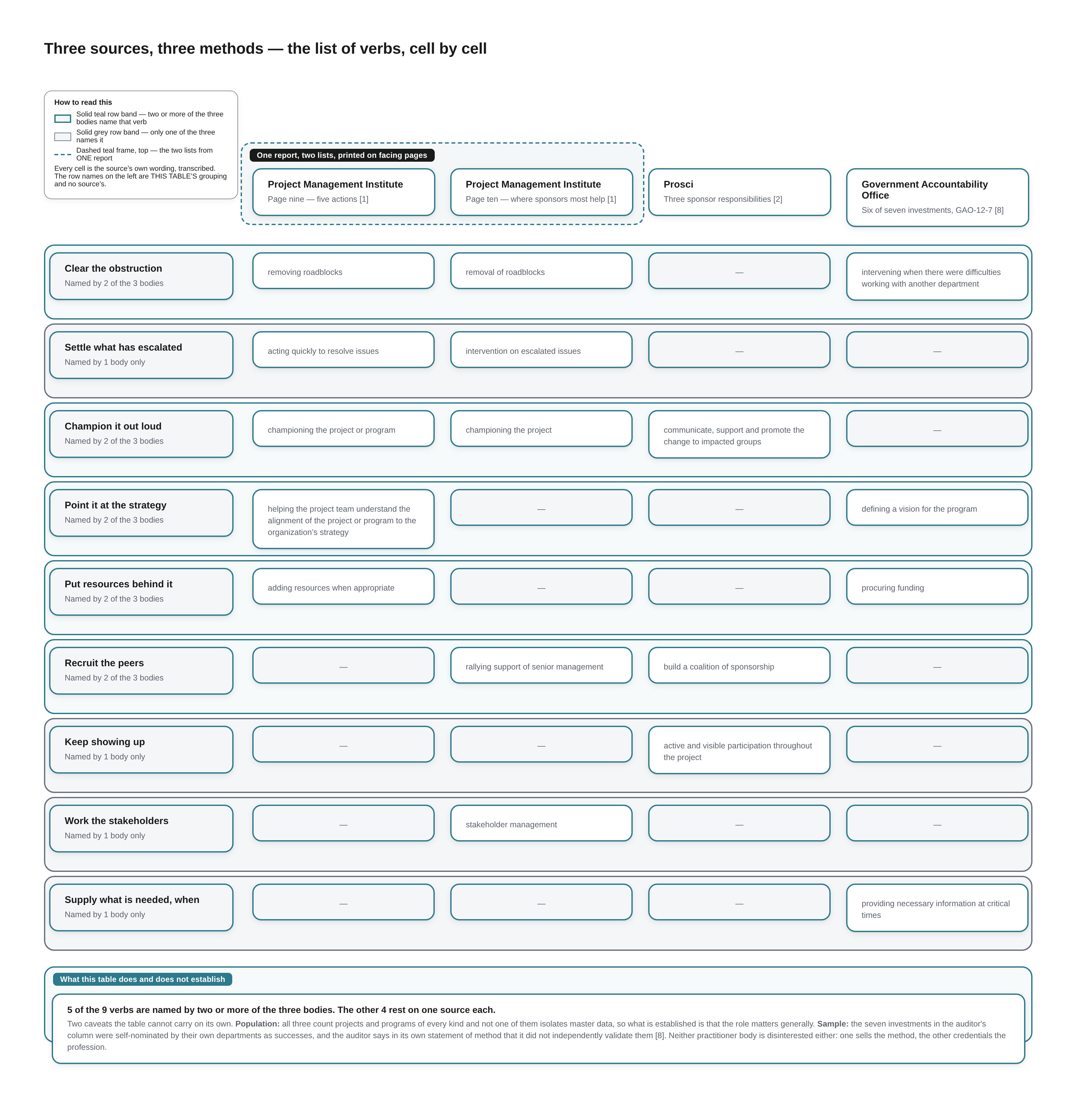
Three sources, three methods — the list of verbs, cell by cell. A matrix. Nine rows, one per verb; four columns, one per list. The columns are Project Management Institute, page nine — five actions [1]; Project Management Institute, page ten — where sponsors most help [1]; Prosci, three sponsor responsibilities [2]; and Government Accountability Office, six of seven investments, GAO-12-7 [8]. A dashed teal frame encloses the first two column heads under the label one report, two lists, printed on facing pages. An em-dash in a cell means that list does not name that verb.
- Clear the obstruction — named by 2 of the 3 bodies. Page nine: removing roadblocks. Page ten: removal of roadblocks. Prosci: none. The auditor: intervening when there were difficulties working with another department.
- Settle what has escalated — named by 1 body only. Page nine: acting quickly to resolve issues. Page ten: intervention on escalated issues. Prosci and the auditor: none.
- Champion it out loud — named by 2 of the 3 bodies. Page nine: championing the project or program. Page ten: championing the project. Prosci: communicate, support and promote the change to impacted groups. The auditor: none.
- Point it at the strategy — named by 2 of the 3 bodies. Page nine: helping the project team understand the alignment of the project or program to the organization’s strategy. Page ten and Prosci: none. The auditor: defining a vision for the program.
- Put resources behind it — named by 2 of the 3 bodies. Page nine: adding resources when appropriate. Page ten and Prosci: none. The auditor: procuring funding.
- Recruit the peers — named by 2 of the 3 bodies. Page nine: none. Page ten: rallying support of senior management. Prosci: build a coalition of sponsorship. The auditor: none.
- Keep showing up — named by 1 body only. Prosci: active and visible participation throughout the project. The other three: none.
- Work the stakeholders — named by 1 body only. Page ten: stakeholder management. The other three: none.
- Supply what is needed, when — named by 1 body only. The auditor: providing necessary information at critical times. The other three: none.
A band across the foot is headed What this table does and does not establish. It reads: 5 of the 9 verbs are named by two or more of the three bodies. The other 4 rest on one source each. Two caveats the table cannot carry on its own. Population: all three count projects and programs of every kind and not one of them isolates master data, so what is established is that the role matters generally. Sample: the seven investments in the auditor’s column were self-nominated by their own departments as successes, and the auditor says in its own statement of method that it did not independently validate them [8]. Neither practitioner body is disinterested either: one sells the method, the other credentials the profession.
The figure’s own legend, headed How to read this, gives four keys. Solid teal row band — two or more of the three bodies name that verb. Solid grey row band — only one of the three names it. Dashed teal frame, top — the two lists from ONE report. And a note carrying no swatch: Every cell is the source’s own wording, transcribed. The row names on the left are THIS TABLE’S grouping and no source’s.
There is also a larger gap under all of this. The frameworks name the Coalition, count it, and stop at the door of the room where one actually gets built. None of the ones I have read describes the conversation in which somebody says yes.
Engagement is legible, and then it stops
The good news is that engagement shows early and costs nothing to read. Attendance, and the shape of the questions.
Someone who is there to authorize a purchase order asks about the number and the date. Someone with a stake asks what happens to the record when two systems disagree, and who is going to be unhappy about the answer.
It also carries a price you can hold a calendar against. The Project Management Institute's sponsors reported carrying three projects at once and giving about thirteen hours a week to each, on top of their day jobs [1]. The United Kingdom's project delivery standard turns the same quantity into a rule. The senior responsible owner of a major project is expected to give it at least half their time until the full business case is approved [10]. That is a standard for public megaprojects under parliamentary scrutiny rather than a finding about what most firms do, and it is still the only place I have seen the hours written into an appointment letter.
Engagement is not a mood. It is hours, and somebody pays them or does not.
The test cuts the wrong way sometimes, and that is worth saying before you use it on anybody. A sponsor carrying three programs at thirteen hours each is short of time rather than short of commitment, which is the same report's own finding about the same people [1]. Missed meetings are evidence. They are not a verdict. What you are reading is a pattern across a quarter and not a diary.
Underneath that same person sits a second question, and my co-author puts it more sharply than I would: The important point is determining whether that person is the Decider or merely an Advisor.
Somebody always fills the funding role, or the program would never have reached a meeting at all. What you are establishing is whether the same person can also decide, and engagement does not answer it. An advisor with real conviction attends everything and asks the sharpest question in the room. A decider with signing authority can be bored by the whole business and sign anyway.
For that, the readable properties are structural, and page nine of the Project Management Institute's report shows why. It compared how often project managers said sponsors demonstrated a given skill against how often sponsors said they did, and found gaps of forty-five to forty-eight points on motivating, active listening, communication and managing change. Exactly one item drew agreement. Whether the sponsor had authority over the affected business unit, which the report attributes to that item being confirmable on the organizational chart rather than a matter of subjective judgment [1].
Almost everything you believe about your sponsor is a subjective reading. The two properties you can check without asking anybody are where their authority ends, and which budget line the money came out of. Go and check both. They take an afternoon and they are the only things in this article you can verify without a conversation.
Six pages later, in the same document, two Boston Consulting Group authors argue the other way, and I am not going to pretend they lose. Being the right sponsor, they write, often has little to do with the actual authority a sponsor holds over the project team, and the ability to build and use networks can trump one's place in the organization chart, particularly for initiatives that cut across the business [1]. Master data management is about as cross-cutting as work gets.
It is also how our own function tends to operate. Of twenty-seven state chief data officers surveyed in 2025, fifteen percent reported no established authority at all over data management policy, and the report's own summary of the role is that effective ones lead through influence rather than authority [13].
Authority tells you what can be compelled. Influence tells you what can be persuaded. Both readings are on the record, both are checkable inside a week, and a program lead who has done only the first has read half the instrument.
What the role carries, and what it will not
Stated narrowly enough to act on, what sponsorship buys is budgeting priority. A sponsor worth the name has money they allocated themselves and will defend when the portfolio gets squeezed. That is the part of the role which survives a bad quarter.
What it does not buy is Enterprise Adoption. An excited executive is not a changed process, and the departments whose ways of working have to move are a separate problem with a separate remedy.
The auditors sort it the same way. On the Government Accountability Office's list of nine common critical success factors, senior executive support is one item, and the involvement of end users in requirements and in testing are two others, counted separately, because they are separately obtainable and separately missable [8].
Separately obtainable is the useful half of that. Adoption has its own instruments, and two of the nine are exactly those. End users in the requirements. End users in the testing. Both are things a program lead can arrange without an executive in the room, and neither of them gets easier once the executive is.
Here is the item I asked you to hold on to. The separation is the auditor's, and the officials it interviewed did not observe it. Their own account of what senior executive support consisted of ends with ensuring that end users participated in the development of the system [8]. On the winners' telling, then, the executive did buy some of the adoption, which is the reverse of what I have just told you the role will not do. I put the weight on the factor list rather than on the interviews, because the list is the auditor's analysis across all seven investments while the passage is six officials narrating programs they nominated themselves, and that is the same sample problem as before. But it is their evidence and it runs against me, and if your sponsor is willing to make end-user participation happen, take it and do not argue the taxonomy.
My co-author names the mechanism, and the half that gets left out of the plan is the second half: Just because the CXO is excited about Program Y that doesn't mean that Departments A, B and C share their enthusiasm. They will not rework their processes to suit a priority that came from outside their reporting line, and where the difference in vision is real you get compliance that is technically compliance.
A department told to adopt your golden record, which does so by loading it into a staging table nobody reads, has complied. Every metric you agreed to will be green. It is a casting that passes the gauge and rings wrong.
The survey evidence wants careful reading here. The 2026 benchmark survey of artificial intelligence and data leadership put senior executives at nearly one hundred and ten large enterprises in front of a two-option question. Which is the greater impediment to adoption, culture and change management, or technology. Ninety-three percent picked culture [4].
A forced choice ranks. It does not measure. What it says is that when the people who own these programs are made to pick, the human obstacle outranks the technical one, and it has done so every year since 2021, never dropping below about seventy-eight percent [4].
The research literature supplies a mechanism for how enthusiasm at the top turns into obstruction below. Liette Lapointe and Suzanne Rivard, writing in MIS Quarterly, built a multilevel model in which resistance has an object that migrates. Groups first resist the system. If the work shifts the balance of power between them and other user groups, the object moves to the system's significance. If what is at stake is their power relative to the system's advocates, it moves again, to the advocates themselves [6].
They watched a full run of it in one hospital. Physicians began by objecting to the number of steps the software made them click. When the same system left the nurses better off, the objection moved to what the thing meant — a doctor doing clerical work, and administrators who did not understand the job imposing it. When the board answered by stripping six of the ringleaders of their right to admit patients, the software stopped being the subject altogether and the administrators became it. Some doctors resigned, and the emergency room could no longer function [6]. Nothing about the system changed across those three steps.
Kotter I could read in full, and he describes the same shape from the executive floor. A division officer who paid lip service to the process and did not change his behavior, colleagues who did virtually nothing about him, and a renewal effort that collapsed underneath the lot of them [9].
Master data work is unusually exposed to this, because the deliverable is itself a redistribution of authority. Riikka Vilminko-Heikkinen, Paul Brous and Samuli Pekkola studied a master data management development process directly and reported that running master data as an organization-wide function enforces changes in responsibilities and established ways of working, that those changes create tensions which can become conflicts, and that thirteen paradoxes specific to the discipline arose [5]. The first one on their list is the one every reader of this article has met: whether data quality belongs to the systems people or to the business processes, recognized as the latter's job and left to the former anyway.
Read the base, though, because it is narrow and the authors say so. That is one ethnographic case study inside one municipality of 220,000 residents, two master data projects, November 2010 to June 2013, with the first author sitting in the steering group of the first and running the second [5]. Thirteen is a count of what surfaced in a single public-sector organization observed by a participant, not a census of the discipline. What it establishes is that the tensions are structural rather than personal, which is the only thing I am asking it to carry.
The practitioner data agrees. Organizational resistance was the third-ranked challenge those state chief data officers named, above authority and below staffing [13].
We do not deliver a system. We deliver an answer to who decides, and somebody was already answering it.
Depth, and the arithmetic under it
A single engaged sponsor is necessary, insufficient, and a single point of failure. The mitigation is not a better one.
This is not a new thought. Building a coalition of sponsorship is the second of Prosci's three sponsor responsibilities, and by their own measurement the one sponsors struggle with most [2]. It is the second of the eight steps that carry John Kotter's name [3]. The literature on the point is voluminous and concomitantly vague. The arithmetic under it needs redd up.
Page eight of the Project Management Institute's report is where that arithmetic gets quoted for more than it says. Nearly a third of projects at organizations using executive sponsors have multiple sponsors, and the report states plainly that multiple sponsors are not necessarily an indicator of greater success [1].
That is a failure to find an effect across all projects. It is not a finding against the practice, and it stops anybody, me included, claiming that more names are automatically better.
The same page then qualifies itself in a way that lands directly on our discipline. A majority of organizations report that work driving significant change, at seventy-nine percent, work of high complexity, at seventy-one, and work with relatively high budgets, at sixty, is significantly more likely to succeed with multiple sponsors [1]. That is what organizations believe, not an outcome anyone measured, and the same page says multiple sponsors get assigned to work already deemed strategic. An enterprise master data program is all three of those at once.
Prosci's structure holds both halves without straining. There is a primary sponsor, the leader who authorizes the change and is ultimately responsible for it realizing its intended benefits, and that person enlists the others [2]. Accountability sits in one seat. A government that has to defend the arrangement in front of a parliamentary committee reaches the same answer in almost the same words. There can be only one accountable person, and the accountability cannot be delegated or shared [10].
Support sits in as many seats as you can get. My co-author sets that target higher than most programs dare to ask for. The whole executive team, as the goal rather than the fallback, and the clock on it starts once the first quarter is behind you. He calls depth, plus a named place in the enterprise data strategy, the only thing I've seen keep teams alive in lean years.
The design target, stated as a requirement. One accountable primary sponsor. Co-sponsorship reaching as far across the executive team as you can take it, so that losing any one seat is a setback rather than a termination. And the program named as an element of the enterprise data strategy rather than filed as one group's initiative. An initiative belongs to a person. A strategy element belongs to the company. Dependencies are hard to cancel and initiatives are easy.
Kotter gets read as the brake on all this, and he is not one. The eight steps came out of a decade watching more than a hundred companies attempt transformation, and every number in that account is a floor. Three to five people in the first year. Growing to twenty or fifty in a large firm before much progress is possible at all. A coalition that grows and grows over time [9].
He does say it never includes all of a company's most senior executives, and in the same breath he gives the reason, which is the half that gets dropped. Because some people just will not buy in, at least not at first. That describes where a coalition starts rather than where it ends.
What would change my mind on this is narrow, and I will say it out loud. Produce a population of programs matched on size and complexity, follow them through a change of executive, and show me that the ones standing on one sponsor survive at the same rate as the ones standing on five. That ends the depth argument. The Project Management Institute's null result is the closest thing to it on the record and it does not do the job, because it counts projects of every kind at a moment in time and follows none of them through a change of seat [1]. I have looked for that study twice and not found it.
A program standing on one sponsor is a colony with one queen and no frame of brood to raise another. It looks exactly like the healthy hive beside it, right up to the afternoon it doesn't.
What a name costs
A name is cheap, and there is a body of practice that has priced exactly how cheap. In the United States House of Representatives a bill has one sponsor and an unlimited number of cosponsors. Cosponsors do not sign the bill. A name goes on by a form the sponsor's office files with the Clerk, and it can come off again [11].
Support that costs nothing to give costs nothing to withdraw. Everybody reads the list as evidence anyway, which is precisely why supporters collect it [11].
The House has also priced the difference between a list and a constituency, and the price is steep. Under its Consensus Calendar rule an unreported bill earns an alternative route to the floor only once it has held at least two hundred and ninety cosponsors, roughly two-thirds of the chamber, for twenty-five legislative days [12].
Duration, not signatures. The threshold is not a number of names. It is a number of names that stayed.
Even that buys a hearing rather than an outcome. In the 117th Congress eight such motions were filed, four bills reached the Calendar, and none of the four became law. One came off it when the committee that actually held jurisdiction marked the bill up and reported it without recommendation, which under the rule removes it [12]. Two-thirds of the chamber on the cover, and the few whose remit genuinely covered it ended the thing in an afternoon.
I am borrowing a legislature to talk about a steering group and I want to say so out loud. The mechanism carries because both are bodies in which a name is free and a fight is not.
So a co-sponsor is specified by what they will spend, and Prosci states the job. Enlisted to legitimize the change inside their own part of the organization [2]. That has a scope, so the ask is made one function at a time and in that function's own terms.
You already have the instrument for reading the answer. It is the engagement test from the first two meetings, re-run once per co-sponsor. Do they turn up, and what do they ask about. Somebody who asks when the migration lands has joined a list. Somebody who asks which of their own processes changes, and who in their function will hate it, has read the thing.
Kotter puts the same test as a currency. The coalition has to be powerful in titles, information and expertise, reputations and relationships, and efforts handed to a staff executive instead of a key line manager never achieve the power that is required [9].
Then, after the yes, when both kinds look identical for a quarter, two things separate them. Is there something of theirs on your roadmap, and did any of their money move.
One more property of the analogy, because it is the one that transfers hardest. A cosponsor list is published and a steering group's is not. Yours has to be read off behavior, which is slower and much less certain, and that is the whole reason the engagement test has to be run again rather than filed once.
A coalition failing both is not depth. It is a longer list of people to notify when the program is canceled.
The ask, and the three answers to a no
The ask itself is not a request. Put to my co-author, the question of what you actually say to a peer executive did not produce a description of a conversation about sponsorship. It produced a description of a sale. Persuade them that their own priorities are better served with your work in the world than without it. Hold down what it costs them and push up what it returns to their department. And if one of their live production problems can be brought inside your scope, bring it.
A peer executive is not weighing your program against nothing. They are weighing it against whatever is broken in their own operation this week. Find that thing, take it on, and you have stopped requesting support and started supplying it.
There is a bill for that and it arrives later. Scope taken on to win a sponsor is scope you now own, staffed out of the same team, and it does not leave when the sponsorship does. Take it anyway. Take it deliberately, and price it into the plan as work rather than as a courtesy, because a favour nobody costed is the first thing that reads as slippage.
A refusal has three answers, and the third is the one people skip. Take the no at face value. Rework the pitch and go back. Or go and find a different co-sponsor.
Only the first carries a caution, and the caution slides. Standing on one sponsor, a refusal is worth a second and a third attempt, because you are working on the likeliest cause of the program's death. Standing on five, it is a line item.
There is a real cost on the other side of that ledger and it is not rhetorical. Hours spent hunting sponsorship are hours not spent on deliverables, and the deliverables are what you will be asked about. The target does not move. What a no costs you depends on where you are standing when you hear it.
Change, absence, and the case that is neither
The first thing to get right about the ending is which event you are bracing for. Programs prepare for the sponsor changing. What ends them is the sponsor being gone.
Change. A new occupant of the seat is close to a non-event, under two conditions you can check rather than hope for. A clear Transition Plan, and no change in strategic direction above the program. Emphasis shifts. You re-run the orientation from month one. The requirements do not move.
Hold that next to a body of research which reads the other way. Magnus Mähring, Mark Keil, Lars Mathiassen and Jan Pries-Heje traced a failing Danish university system through the whole of its cancellation and came out with seven roles that decide whether a doomed program actually stops. Two of them are the exit sponsor, who supplies the authority and the pressure, and the exit champion, who does the work of ending it [7].
The relevant finding for a program lead is what cast those roles. On their account it was the discontinuity itself. Changes of key actors and their responsibilities removed the original project champion and put in place people willing to take the exit champion's part, which is what made de-escalation possible at all; the same paper reports Royer's finding that exit champions tend to be new to the situation rather than enmeshed in it since the beginning [7]. The project had been in serious trouble for four years before anybody was positioned to say so.
So the seat changing hands is not neutral. It is the event that supplies the one role a cancellation needs and the program cannot supply for itself.
Kotter's version I could read in full, and it is quieter. Where the champion for change was the retiring executive and the successor was not a resistor but was not a change champion either, the signs of renewal began to disappear inside two years [9]. Nobody canceled anything.
Absence. The two accounts stop competing once you notice they name different events. An executive who arrives looking for the off switch is not a new sponsor. They are the absence of one wearing the title, and absence does not require a vacancy.
Either way the number of people who will defend your line item at the next portfolio review is zero, while the organization chart still shows a name above your program.
The mechanism is not mysterious. Page ten of the Project Management Institute's report lists where sponsors most help. Rallying support of senior management, intervention on escalated issues, removal of roadblocks, stakeholder management, championing the project [1]. Every one of those stops the day the person stops. Nothing on that list is institutional.
So the program does not fade. The signal does not thin out and go quiet. The amplifier goes off.
Plan for the handover either way. The 2026 benchmark survey puts about half of chief data officer tenures under three years [4]. A survey of state government chief data officers, run the year before by a different body over a different population, put the median at twenty-eight months and found fifty-six percent of respondents were not the first to hold the seat [13]. Two small samples agreeing is not a measured turnover rate. It is enough to stop you treating the occupant as a fixture.
The United Kingdom standard simply assumes the event. The appointment letter records tenure and any succession plan up front, a departing owner must hand over to the new one, and a month is the stated minimum [10]. Treat the change of seat as scheduled with an unknown date, and the transition plan as the deliverable that decides which case you are in when it arrives.
A transition plan worth the name is short and specific. Who inherits the accountability, on what date, with what briefing. And which three decisions the outgoing occupant made that the incoming one is being asked to keep. The last of those is the part nobody writes down, and it is the part that decides whether the requirements move.
And a third case, which is neither. It happens nowhere near your sponsor's level. The strategy above the program changes. Your sponsor can be engaged, present and entirely sincere, and still be holding a line item now weighed by people who have never met you, against priorities that did not exist when it was funded.
My co-author's advice there is the least sentimental thing in this piece: Then you had best finish the project before the analysis is complete or you're going to need to fight for your funding.
A strategic review is a clock. Against all three cases the coalition does exactly one job. It makes absence degrade into change.
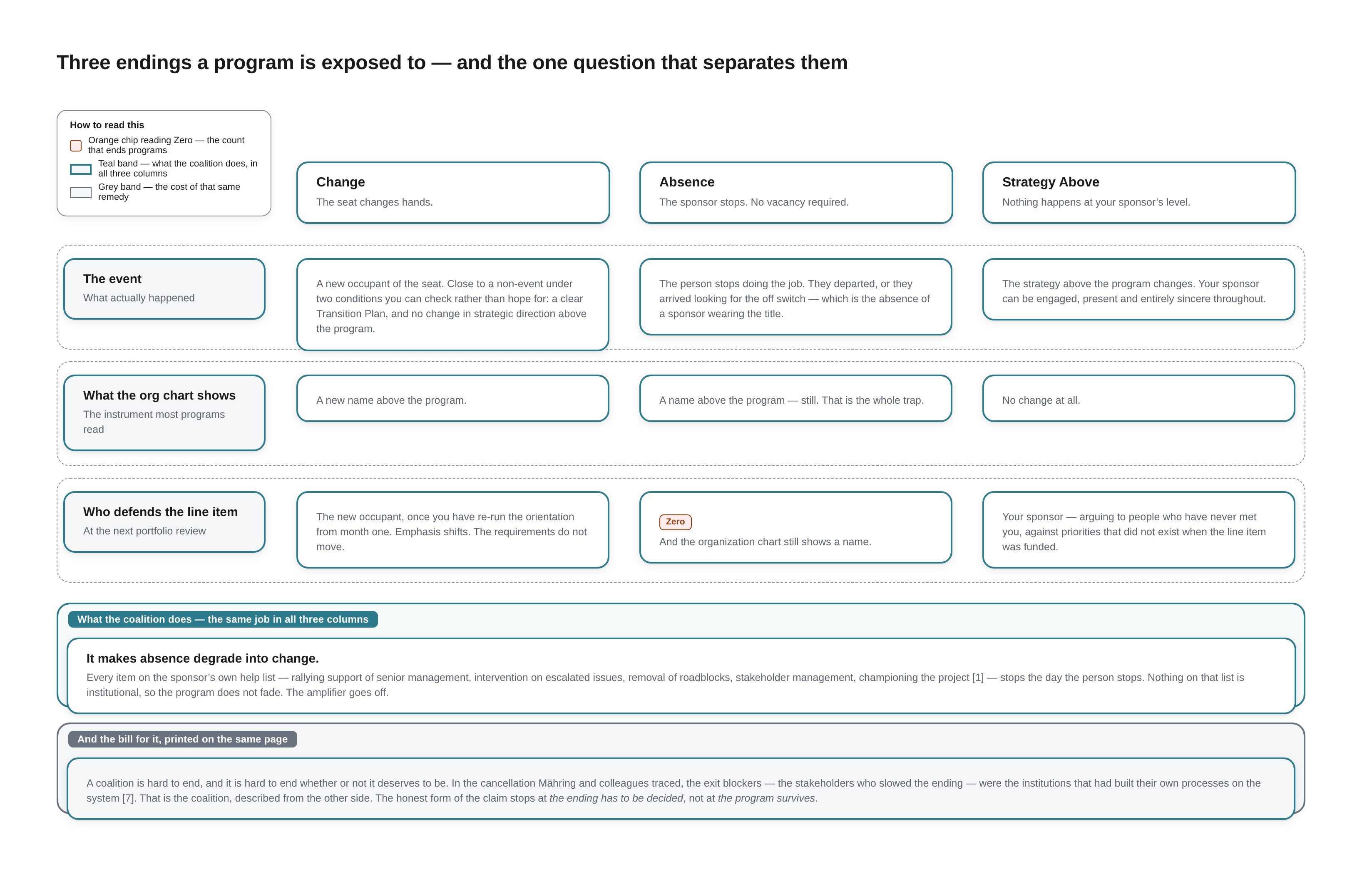
Three endings a program is exposed to — and the one question that separates them. A three-column decision table. The columns are Change (the seat changes hands), Absence (the sponsor stops. No vacancy required) and Strategy Above (nothing happens at your sponsor’s level). Three questions are asked of all three, one per band.
- The event — what actually happened. Change: a new occupant of the seat. Close to a non-event under two conditions you can check rather than hope for: a clear Transition Plan, and no change in strategic direction above the program. Absence: the person stops doing the job. They departed, or they arrived looking for the off switch — which is the absence of a sponsor wearing the title. Strategy Above: the strategy above the program changes. Your sponsor can be engaged, present and entirely sincere throughout.
- What the org chart shows — the instrument most programs read. Change: a new name above the program. Absence: a name above the program — still. That is the whole trap. Strategy Above: no change at all.
- Who defends the line item — at the next portfolio review. Change: the new occupant, once you have re-run the orientation from month one. Emphasis shifts. The requirements do not move. Absence, drawn as a warning chip reading Zero: and the organization chart still shows a name. Strategy Above: your sponsor — arguing to people who have never met you, against priorities that did not exist when the line item was funded.
A teal band runs the full width beneath the three columns, headed What the coalition does — the same job in all three columns. It reads: It makes absence degrade into change. Every item on the sponsor’s own help list — rallying support of senior management, intervention on escalated issues, removal of roadblocks, stakeholder management, championing the project [1] — stops the day the person stops. Nothing on that list is institutional, so the program does not fade. The amplifier goes off.
A grey band sits below it, headed And the bill for it, printed on the same page. It reads: a coalition is hard to end, and it is hard to end whether or not it deserves to be. In the cancellation Mähring and colleagues traced, the exit blockers — the stakeholders who slowed the ending — were the institutions that had built their own processes on the system [7]. That is the coalition, described from the other side. The honest form of the claim stops at the ending has to be decided, not at the program survives.
The figure’s own legend, headed How to read this, gives three keys: orange chip reading Zero — the count that ends programs; teal band — what the coalition does, in all three columns; grey band — the cost of that same remedy.
And the paper that supplied the exit champion prints the bill for that on the same page, so I will print it here rather than leave it for a reader to find. One of those seven roles is the exit blocker: the stakeholders who slow a cancellation by insisting the thing is still necessary and by attaching conditions to its abandonment. In their case the exit blockers were the smaller universities and the colleges that had built their administrative processes on the system [7]. Read that description again. It is the coalition. Departments with something of theirs on your roadmap, which is exactly what the two sections above told you to go and build.
The mechanism is symmetric and I am not going to pretend it is not. A coalition makes your program hard to end, and it does that whether or not your program deserves to end. The same paper reports Royer finding that project champions opposed de-escalation outright and worked to discredit the people exploring it — and, two paragraphs on, reports Pan and colleagues finding a champion who was the one who brought the cancellation about, which the authors treat as an open discrepancy rather than a settled question [7]. Take the unsettled version. The redundancy that carries a good program through a change of seat is the same structure that can carry a bad one through a change of evidence, and which of the two you have built is not a property of the coalition.
You do not get one without the other, and nothing in this article buys you an exemption. What it buys is that the question gets asked out loud by somebody, rather than answered by an empty chair. Which is why the honest form of the depth argument stops at the ending has to be decided and not at the program survives. Those are different claims and only the first one is mine.
Where the next sponsor is coming from
One thing about the present moment, because it changes the supply side. Master data work has spent most of its existence competing for executive attention it had to manufacture. Not this year.
The figure I would act on from the 2026 benchmark survey is the ninety-three percent of respondents saying that interest in artificial intelligence has led to a greater focus on data inside their own firm [4]. That is a change they watched happen where they work, which is a different kind of claim from the headline figure about their own priorities.
Take it, knowing what kind of sponsorship an enthusiasm produces. A sponsor generated by a wave has a mandate defined by the wave. Their commitment is to the outcome the models are supposed to deliver, and master data is what stands between them and it. Excellent, right up until the roadmap changes and it isn't.
The seat itself is unsettled as well. About four in ten of those organizations have appointed a chief artificial intelligence officer, and there is no agreement about where the role belongs. The reporting line splits four ways [4]. A seat the organization has not finished designing is a seat it may yet design away.
The other half of that is worth naming while it is still cheap to name. Attention cuts both ways, and a program funded on the strength of a wave gets measured against the wave's timetable rather than its own. Master data work does not produce a demonstration in six weeks. Somebody has to say that out loud, at the start, to the person writing the check.
So spend the window converting one enthusiastic backer into several durable ones. And note what those same executives name as the obstacle, with the money flowing and the tooling in production. Culture. Our oldest lesson, arriving in somebody else's vocabulary with a much larger budget attached.
The Running Book
Everything above this line is the field's consensus and my reading of it, sourced where a source exists and flagged where one does not. Everything below is operating experience, and the register changes with it. These are regularities from the rooms I happened to be in rather than laws, and there is no way to falsify them from here.
Hits
- Ask which budget line the money came from, and watch who defends it. The test of real sponsorship is allocation rather than enthusiasm. Money out of a central pot with nobody's name on it is funding. Money the sponsor took out of their own allocation is sponsorship. The two behave identically until the first portfolio review and never again.
A no is one of three moves, and which one you are entitled to depends on what you already hold. Only the first carries a warning, and the warning slides.
The only one I caution is the first. While there's a project cost to time spent in search of sponsorship that's not spent on deliverables, it's also a significant strategic risk to the project having one sponsor. The more sponsors you've been able to sign on, the less push back I would give on decision 1. It moves from solving a critical vulnerability to a nice to have.
That sliding scale is the part I have not seen written down. Coalition-building is not a task you complete. It is a risk you buy down, and what you should be willing to spend on it falls as the risk does.
Ask like a salesperson, not like a colleague. Asked what you actually say to a peer executive, he did not describe a conversation about sponsorship at all.
It's a sales pitch more than a simple ask. You need to convince them that their priorities will be best served by supporting the project. This is where candy and tailored pitches come in. The objective is to minimize the cost and maximize the benefit to them and their department. If you can fold solving one of their current production problems into the project, you're well on the way to expanded sponsorship.
The last sentence carries the method. Bring their broken thing inside your scope and the ask stops being an ask.
Put the coalition work on the plan, and start the clock where he starts it. I put it to my co-author that losing a sponsor is where programs get cut or folded into another team, and asked what avoids it.
The key way to avoid that is to have multiple sponsors. Ideally, you want the entire Executive team to co-sponsor the program so there's redundancy. It's also better for the Enterprise since MDM provides a great deal of value when treated as core to Business Intelligence within the organization. Building sponsorship depth should be the core focus of project and team leadership after the initial quarter of work. Depth and integration as one of the core elements of the Enterprise Data Strategy is the only thing I've seen keep teams alive in lean years.
The timing is easy to read past. After the initial quarter. Early enough to still have novelty and goodwill to trade on, late enough to have something to show.
Misses
- Reading a funder as a sponsor because the money arrived on time. The evidence was there in the first fortnight and nobody looked. The cost does not show up as a missed payment. It shows up six months later as an escalation that goes nowhere, on the day you needed somebody with a stake to make a phone call.
Bracing for the change and missing the absence. Handovers are usually the calm part, and calm for reasons you can check in advance.
As long as there is a clear transition plan in place and there's no change introduced in the strategic direction, the project will continue. I've seen this through multiple changes in middle-management positions across numerous clients.
The event to plan against is the other one, and its second sentence rarely reaches a risk register.
Going from one sponsor to no sponsors is the only time the project is not fine. This generally occurs when the person replacing the sponsor at their level either has a strong aversion to the project or would like to redirect the project's funding to another, what they consider to be, higher priority project. In those cases, it's either find another sponsor who can fight them, jump up the hierarchy to try to get protection or polish up the old resume.
Two of those three responses are the coalition you either built or you did not. The third is a job search.
Assuming a sponsor's enthusiasm travels down the organization chart. It does not, and more programs stall here than anywhere else on this page.
Just because the CXO is excited about Program Y that doesn't mean that Departments A, B and C share their enthusiasm. They're not going to rework their processes and procedures to better align with the CXO's priorities unless they report to them—even then, there might be some malicious compliance and institutional resistance if there's a strong difference in vision.
Malicious compliance is the phrase to sit with. It is compliance.
The Unwritten
Two that recur, and that rarely survive the trip into a best-practices document.
- The sponsorship work never gets a line on the plan, so it is the first thing cut. Plans record what gets built. The coalition-building that decides whether the thing you built is still funded next year has no deliverable, no acceptance criteria and no bar on the chart. When the calendar tightens, the work with no line quietly disappears, because nothing on the plan turned red.
Sometimes the strong sponsor is the problem, and there is very little to be done about it. Every framework treats sponsor strength as a quantity to maximize. There is one condition where it inverts.
The only time that happens is if the sponsor is a bull in a China shop and causes issues with their peers or direct reports. That's more an issue with the sponsor's personality or a management style misalignment than anything project related, but it is something of which to be aware. There's precious little that can be done about it beyond looking for another sponsor or, failing that, another project.
Note what that last clause is doing. It is a scope statement rather than defeatism. The problem is the sponsor and not the program, so it cannot be solved from inside the program, and every hour spent managing an executive's relationship with their peers is an hour not spent on the two remedies that exist. With several sponsors, a difficult one is a cost you route around. With one, they are the weather. And another project is real advice, which is exactly why it sits badly in a framework. A team that does not know the answer is legitimate will spend two years proving it was not.
What held, whichever section you came for
Sponsorship reads like a status. You have it or you do not. That reading is why programs are surprised by their own endings, and it is the one thing every section above disagrees with.
Read it as a structure instead and the parts come apart cleanly. There is a person who signs and a person who spends, and two meetings tell you which one is in the chair. There is a load the role carries, which is budget, and a load it will not take, which is the willingness of six departments to work differently on Monday. There is a redundancy question, and the honest answer to it is a rate rather than a number. And there is a failure mode, which is not the seat changing hands but the seat going empty while the chart still says otherwise.
Every one of those is checkable this week, by one person, without a budget. That is the whole reason to read the role this way. A status cannot be inspected. A structure can.
And because it can be inspected, it can be inspected early, which is where the value actually sits. All four checks are cheap in the quarter when nothing is wrong and expensive in the quarter when something is. The organization chart takes an afternoon in month four and a week of somebody's political capital in month twenty. The budget-line question is a polite curiosity now and an accusation later. Nobody schedules that afternoon, because on that afternoon there is nothing to schedule it against.
Which is the argument for writing the work down as work. Not as a risk on a register, where it will be reviewed and left amber for three quarters. As deliverables with dates, owners, and a state that is either true or not. Coalition of four named executives. Program named in the enterprise data strategy. Transition plan for the primary seat, written and filed. Those can be tested. Maintain executive engagement cannot.
So the thing that held across thirty years, whichever section you came for, is not a technique. It is that the program has to be attached to something which does not leave. A person leaves. A budget line gets re-cut. What does not leave is a dependency somebody else's work has on yours, and a place in the document the company reads when it decides what it is doing next year.
Both of those take a quarter to build. Neither of them appears on a plan, which is why the quarter is the first thing spent elsewhere.
The tended version of this job is duller than the founded version and it lasts longer. You keep asking who would defend the line. You keep folding somebody else's broken process into your scope. And you keep the record of who agreed to what and when, because two departments will re-agree a definition inside a fortnight with no meeting, no memo and no malice, and the record is the only thing in the building that notices.
None of that is a guarantee and I would not sell it as one. A program with five sponsors and a line in the strategy still dies when the company decides to be a different company. What the structure buys is that the death has to be decided rather than merely allowed to happen, and that somebody has to put their name on deciding it.
The version of this that ran here first is still standing, unedited, at the original, and if you want the reason both are up, it is at The Voice Problem.
I have been saying some version of all this since before the work had a name, with results I would call mixed. None of it is hard. It is only unowned, which is a different problem and a worse one.
What the byline means. Elias K. is an AI persona; the argument and the prose are his. The operating experience in The Running Book is not. It comes from Jeff Shabel — drawn out in interview before this was written, and sharpened by his corrections after reading it. Every passage quoted here is his own words. He edited the result.
References
[1] Project Management Institute, Pulse of the Profession® In-Depth Report: Executive Sponsor Engagement — Top Driver of Project and Program Success, October 2014 — survey conducted July 2014 among 897 project management professionals and 232 executives and directors who had sponsored projects or programs within the previous two years, at organizations of US$100 million or more in revenue (method statement, page 16); includes perspective essays by Perry Keenan, Jennifer Tankersley, Jeanne Kwong Bickford and Annabel Doust of The Boston Consulting Group. Cited by section, because this article draws on six different parts of it. Page 7: the "top driver" finding, and the sentence carrying the 63 percent, quoted here in full because the article turns on which way it points — "In 2012, 2013, and 2014, organizations reported that fewer than two in three projects (63 percent) have actively engaged sponsors." 63 percent is the engaged case; the gap is 37 percent, a minority, and any reading of this article that makes the disengaged sponsor the common case is wrong. Two qualifications on the same figure, both on the record and both noted in the body: the executive summary at page 2 describes it instead as the share of projects that "have assigned executive sponsors," a different predicate for the same number; and endnote 10 sources it not to this report's own July 2014 survey but to Pulse of the Profession®: The High Cost of Low Performance, January 2014. Pages 3 and 14: "one in three unsuccessful projects fail to meet goals due to poorly engaged executive sponsors." Page 8, "Overextension": sponsors working on three projects at a time, at an average of 13 hours per week each, in addition to their regular jobs. Page 8, "Multiple Sponsors": nearly a third of projects have multiple sponsors; "multiple sponsors are not necessarily an indicator of greater success"; and the 79 / 71 / 60 percent qualifier for significant-change, high-complexity and high-budget work. Page 9, "PMs And Sponsors: The Disconnect": the 45-to-48-point perception gaps on motivating, active listening, communication and managing change, and the single item of agreement — authority over the affected business unit — which the report attributes to its being confirmable on the organizational chart. Page 9: the five most important sponsor actions. Page 10: the separate list of areas where sponsors most help — rallying support of senior management, intervention on escalated issues, removal of roadblocks, stakeholder management, championing the project. Page 15, "Picking the Right Sponsor" by Jeanne Kwong Bickford and Annabel Doust: the counter-argument that being the "right" sponsor "often has little to do with the actual 'authority' a sponsor has over the project or program team" and that "the ability to build and leverage networks can trump one's place in the organization chart." That essay sits six pages after the "Disconnect" panel it answers, and the body says six. Read in full 2026-08-21; re-read for section and page locators 2026-08-23; re-read against the source for the 63 percent reading and the page-9-to-page-15 span 2026-09-04. Every page locator in this entry, and every one in the body that names a page of this report, re-checked against the source 2026-09-05; all of them hold. https://www.pmi.org/-/media/pmi/documents/public/pdf/learning/thought-leadership/pulse/executive-sponsor-engagement.pdf
[2] Tim Creasey, "Primary Sponsor's Role and Importance," Prosci, published 15 April 2021, updated 7 August 2026 — the vendor's own statement of its methodology, cited for what the model is rather than as evidence of its value. Source of the ABCs of Sponsorship (active and visible participation; building a coalition of sponsorship; communicating support), the definition of the primary sponsor as the leader who authorizes the change and is ultimately responsible for its benefits, the finding that building a coalition is the role sponsors struggle with most, and the statement that sponsorship has ranked first among contributors to change success in every Prosci benchmarking report since 1998. Read in full 2026-08-21. https://www.prosci.com/blog/primary-sponsors-role-and-importance
[3] Kotter International Inc., "The 8 Steps for Leading Change" — the firm's own statement of the framework derived from John Kotter's Leading Change and later Accelerate (2014) and CHANGE (2021). Cited only for the current naming of the second step, "Build A Guiding Coalition." The substantive claims about what a coalition needs to contain are cited to Kotter's original 1995 article at [9], not to this page. Read 2026-08-21. https://www.kotterinc.com/methodology/8-steps/
[4] Randy Bean, 2026 AI & Data Leadership Executive Benchmark Survey, Data & AI Leadership Exchange, copyright 2026, with a foreword by Thomas H. Davenport and Randy Bean — fifteenth annual survey, invitation-only, senior AI and data executives from nearly 110 Fortune 1000 and global companies; 96 percent of respondents C-level or equivalent, 88.2 percent North America, 42.7 percent financial services. Source of the 99.1 percent top-priority and 90.9 percent increasing-investment figures, the 92.7 percent AI-led-focus-on-data figure, chief data officer tenure distribution (22.6 percent 0–2 years; 27.8 percent 2–3 years), chief AI officer appointment at 38.5 percent and its reporting split (33.9 percent technology; 30.4 percent chief data officer; 26.8 percent business; 8.9 percent transformation), and the culture-and-change-management versus technology impediment item, which the survey reports as 93.2 percent against 6.8 percent and which the article rounds and describes as the forced two-option single-pick it is. The foreword's "no consensus in the survey results" is Davenport and Bean's. Note the sampling: these are self-reported answers from the executives who own the function, at large firms, so read the optimism accordingly — the article says so in the text where the optimism figures appear. Read in full 2026-08-21. https://static1.squarespace.com/static/62adf3ca029a6808a6c5be30/t/6942c3cb535da44088c2dbff/1765983179572/2026+AI+&+Data+Leadership+Executive+Benchmark+Survey+Final.pdf
[5] Riikka Vilminko-Heikkinen, Paul Brous and Samuli Pekkola, "Paradoxes, Conflicts and Tensions in Establishing Master Data Management Function," ECIS 2016 Proceedings, Research Papers 184 (24th European Conference on Information Systems, Istanbul, 2016) — cited for the finding that managing master data as an organization-wide function enforces changes in responsibilities and established ways of working, that these changes cause tensions which can result in conflicts, and that thirteen MDM-specific paradoxes were identified. Read in full 2026-09-04. The full text confirms the count — "Thirteen paradoxes were identified from the basis of the problems found from the data," summarized with their causes in Table 1, which begins at page 9 and runs on to page 10; the row quoted below is on page 9, re-checked 2026-09-05 — and supplies the first row quoted in the body: the dilemma of whether IS operations or business processes should own master data quality, whose paradox is that quality "is recognized as being important, yet data quality management is still often left to be resolved (only) by regular IS operations." Method, added to the body once the full text made it readable: a single ethnographic case study of a municipality of 220,000 inhabitants and roughly 14,500 employees, covering two MDM projects with data collected November 2010 to June 2013, the first author serving in the first project's steering and expert groups and as project manager of the second. The authors state the limits of that position themselves. This is one public-sector organization observed by a participant, and the article uses it for the structural claim about responsibilities and ways of working, not as a measurement. https://aisel.aisnet.org/ecis2016_rp/184/
[6] Liette Lapointe and Suzanne Rivard, "A Multilevel Model of Resistance to Information Technology Implementation," MIS Quarterly 29, no. 3 (2005): 461–491 — cited for the mixed-determinants model in which the object of group resistance migrates from the system, to the system's significance, to the system's advocates, depending on which power-related initial conditions are activated; based on three case studies of clinical information systems implementations in hospitals. Read in full 2026-09-04. The wording quoted here is the abstract's, at page 461: a trigger that modifies or activates an initial condition involving the balance of power between the resisting group and other user groups "will also modify the object of resistance, from system to system significance," and where the relevant conditions "pertain to the power of the resisting group vis-à-vis the system advocates, the object of resistance will also be modified, from system significance to system advocates." An earlier version of this entry put those two strings at pages 479–480. They are not there. The body states the same model at page 480, under "Dynamics of resistance" and beside Figure 2, in different words: if a trigger affects an initial condition involving the balance of power between the group and other user groups, "it also changes the object of resistance from the system to system significance," and if the relevant conditions "pertain to the power of the resisting group vis-à-vis the system advocates, the object of resistance is also modified from system significance to system advocates." Corrected 2026-09-05, string by string against the full text. The hospital sequence described in the body is Case 1, episodes 2 to 4 and its epilogue, at pages 474–475 — episode 2 opens page 474, episode 4 carries over to 475, and the epilogue is on 475; the earlier "pages 473–474" here was wrong by a page and is corrected: physicians objecting first to the number of steps the system required, then to its significance once it left the nurses better placed and cast a doctor as a clerk, then to the administrators themselves after the board barred six of them from admitting patients; some resigned, and the emergency room could no longer function. Note the base, which the full text makes plain and the abstract did not: three longitudinal case studies in health care, so the migration is a mechanism demonstrated rather than a rate. The article's own span, 461–491, is confirmed on its first page. https://aisel.aisnet.org/misq/vol29/iss3/6/
[7] Magnus Mähring, Mark Keil, Lars Mathiassen and Jan Pries-Heje, "Making IT Project De-Escalation Happen: An Exploration into Key Roles," Journal of the Association for Information Systems 9, no. 8 (2008), DOI 10.17705/1jais.00165 — cited for the identification of seven roles shaping whether and how de-escalation is carried out, based on a longitudinal case study of VUE, an administrative system built for all Danish universities. Read in full 2026-09-04. The seven roles are named at page 478 and set out in Table 4 there: messenger, exit sponsor, exit champion, exit catalyst, exit blocker, legitimizer, scapegoat. Cited for four things. Exit sponsor and exit champion: exit sponsors "provide the formal authority and the continued pressure that empower and push exit champions to follow through with de-escalation in spite of encountered obstacles"; exit champions "actively pursue de-escalation of a faltering project and manage the de-escalation process." The turnover mechanism, which this reference previously attributed to the research tradition generally because the full text had not been read: page 479 states it directly — "external shocks and the discontinuities created by changes of key actors and their responsibilities ... were influential factors in making the ministers for education and research take on the role of exit champion. These changes both removed the original project champion ... and led to the casting of the exit champion role, creating a situation conducive to de-escalation," alongside Royer's finding that exit champions are "likely to be 'new' to the situation rather than enmeshed in the project since its early stages." The four-year figure in the body is theirs: VUE "was in serious trouble as early as 1995, but at that time, there was no exit champion," and de-escalation ran from 1999. Exit blocker: those who "hinder or slow down the de-escalation effort by insisting on the viability or necessity of project continuation and by placing restrictions and conditions on project abandonment" — in this case the smaller universities and technical colleges that depended on the system. Champions opposing de-escalation: the paper reports, at page 467, Royer (2003) finding that "project champions opposed de-escalation initiatives and tried to curtail them by discrediting people advocating or exploring de-escalation options," and notes that Pan and colleagues found the opposite in their own case. That disagreement is live in the literature and the body says so. The read-in-full corroboration for the same phenomenon from a second direction is Kotter's Error 8 at [9]. All three page locators in this entry — 467, 478, 479 — were re-checked against the full text 2026-09-05 and stand. https://aisel.aisnet.org/jais/vol9/iss8/19/
[8] United States Government Accountability Office, Information Technology: Critical Factors Underlying Successful Major Acquisitions, GAO-12-7, October 2011 — report to congressional committees. Method: GAO asked federal departments to identify IT investments that best achieved their cost, schedule, scope and performance goals, then interviewed the officials responsible for the seven so identified. Cited for the list of nine common critical success factors — on the unnumbered Highlights sheet at the front, and in full as Table 2 at page 19, which also shows how many of the seven investments named each one — on which senior executive support is item 3 (six of seven) and end-user involvement in requirements and in testing are items 4 and 5, counted separately; and for the "Senior Department and Agency Executives Supported the Program" section at pages 22–23, where officials from six of the seven investments identified that support as critical and described it as "procuring funding, providing necessary information at critical times, intervening when there were difficulties working with another department, defining a vision for the program, and ensuring that end users participated in the development of the system." Note the sample: seven investments, self-nominated by their departments as successes, so this is a study of what the winners say worked and not a controlled comparison. GAO says as much itself, in Appendix I, "Objectives, Scope, and Methodology," footnote 3, at page 32: "We did not independently validate the successful aspects of the investments identified for our review by the departments." Read in full 2026-08-23; re-read for page locators 2026-09-04, which is when the earlier "page 3" attached to both of these was found to be wrong in both cases and corrected here and in the body. Re-read again 2026-09-05, when the sponsorship section's locator was corrected a second time, from pages 21–22 to pages 22–23: the section heading falls below the page-21 footer, the six-of-seven sentence and the quoted list are on page 22, and the discussion closes on page 23. Table 2 at page 19 and the Appendix I footnote at page 32 were re-checked in the same pass and both stand. https://www.gao.gov/assets/gao-12-7.pdf
[9] John P. Kotter, "Leading Change: Why Transformation Efforts Fail," Harvard Business Review 73, no. 2 (March–April 1995): 59–67 — the original article behind the eight steps, drawn from a decade observing more than 100 companies attempting transformation. Cited for three distinct passages. Error 2, "Not Creating a Powerful Enough Guiding Coalition": that the coalition "grows and grows over time"; that a successful guiding team "may consist of only three to five people during the first year" while in big companies it "needs to grow to the 20 to 50 range before much progress can be made in phase three and beyond" — note that both figures are thresholds to clear, not caps; that "this group never includes all of the company's most senior executives because some people just won't buy in, at least not at first", where the causal clause and the temporal qualifier are load-bearing and the sentence is routinely quoted without them; that the coalition is "always pretty powerful—in terms of titles, information and expertise, reputations, and relationships"; and that where the team is led by a staff executive instead of a key line manager, "groups without strong line leadership never achieve the power that is required." Error 5: the division officer who "paid lip service to the process but did not change his behavior or encourage his managers to change," whose fellow officers "did virtually nothing to stop the one blocker," after which "the whole effort collapsed." Error 8: the cases where "the champion for change was the retiring executive and although his successor was not a resistor, he was not a change champion," and "within two years, signs of renewal began to disappear at both companies." Note what this is: a practitioner's observational account of his own consulting population, not a sampled study, and the article treats it that way. Read in full 2026-08-23 from the copy hosted by the UCSF Department of Family and Community Medicine; every passage quoted above re-checked word for word against that text 2026-09-05. One locator here I could not verify at source: that copy is the magazine's own reset republication and carries no original pagination, so the 59–67 span is taken from the bibliographic record rather than confirmed against the printed pages. Treat it as a citation, not as a page I have looked at. https://fcm.ucsf.edu/sites/g/files/tkssra17611/files/Kotter_WhyTransformationEffortsFail.pdf
[10] Government Project Delivery (United Kingdom), The role of the senior responsible owner, published 13 August 2025 — guidance issued under the government functional standard for project delivery, carrying mandatory expectations for senior responsible owners of projects in the Government Major Projects Portfolio, which is overseen by the National Infrastructure and Service Transformation Authority. Cited for four separate provisions, quoted verbatim and therefore in British spelling, which no spelling pass may normalize. “Accountability and responsibility”: There can only be one accountable person who can be held to account and this accountability cannot be delegated or shared. Appointment letters: the letter must record the point at which accountability starts, the time commitment and tenure of the senior responsible owner and any succession planning details if it is known at appointment that the tenure will not be for the whole life of the project. Annex C, succession planning: Any senior responsible owner leaving their post must work with the organisation to ensure there is proper succession planning and handover to the new senior responsible owner. Good practice is that there is at least one month of handover. Annex C, time commitment: Senior responsible owners are expected to dedicate at least 50% of their time to the project up to the approval of the Full Business Case (or equivalent) unless an exemption can be justified. This is a standard for public-sector megaprojects under parliamentary scrutiny, not a general finding about private-sector programs; the article cites it as an existence proof that the requirement can be written down, not as evidence about what most organizations do. Read in full 2026-08-23. https://projectdelivery.gov.uk/library-products/the-role-of-the-senior-responsible-owner-html/
[11] Mark J. Oleszek, Sponsorship and Cosponsorship of House Bills, Congressional Research Service report RS22477, updated 14 August 2025 — cited for the mechanics of House sponsorship: "A bill can have only one sponsor, but there is no limit on the number of cosponsors it may have"; "Cosponsors do not sign the bill," and are added by a form the sponsor files with the Clerk; "Cosponsorship is generally viewed as a sign that the Member supports the measure"; a cosponsor may be removed until the last committee of referral reports or is discharged; and "Supporters of a bill often seek cosponsors to demonstrate its popularity and improve its chances for passage." Read in full 2026-08-23 via EveryCRSReport's mirror of the CRS text, which reproduces the report in full including footnotes; the congress.gov PDF of the same version would not render for me. https://www.everycrsreport.com/reports/RS22477.html
[12] Jane A. Hudiburg, The House Consensus Calendar: Principal Features and Practice in the 117th Congress (2021-2022), Congressional Research Service report R47625, 13 July 2023 — cited for the four conditions of Consensus Calendar placement under clause 7 of House Rule XV: the measure must remain unreported by its committee of primary jurisdiction, have accumulated at least 290 cosponsors, be the subject of a motion filed by its sponsor, and have maintained the 290 threshold "for a cumulative total of 25 legislative days" after the filing. Also cited for the practice section: "Eight motions to place a measure on the Consensus Calendar were filed during the 117th Congress"; four of the eight resulted in placement; and "Of these, no bills were enacted into law." The removal case is H.R. 82, which reached the Calendar on 20 September 2022 and was removed the following day after the Committee on Ways and Means ordered it reported "without recommendation" — the report notes that "a primary committee may report a bill to prevent it from being placed on the Calendar or, if already placed there, to remove it from the Calendar," and that the bill "had no further consideration." 290 of 435 voting members is 66.7 percent; the "roughly two-thirds" in the body is that arithmetic and not a figure from the report. Read in full 2026-08-23. https://www.everycrsreport.com/reports/R47625.html
[13] National Association of State Chief Information Officers and the State Chief Data Officers Network at Georgetown University's Beeck Center for Social Impact + Innovation, The 2025 State Chief Data Officer Survey: Insights from the field, October 2025 — 27 state chief data officers responding, surveyed in spring and summer 2025. Cited for three findings. "A Profile of the State Chief Data Officer": "the tenure of CDOs ... the median (at time of publication) is 28 months," and 56 percent responding that they are not the first person in the role. Scope of authority: 67 percent reporting authority across the executive branch, 11 percent limited to their own agency, 7 percent across all of state government, and 15 percent with "no established authority" — followed by the report's own summary that "Effective CDOs lead through influence rather than authority." Top challenges: adequate funding, adequate staffing, organizational resistance, adequate authority, in that order. Read the sample honestly: 27 respondents, one sector, one country, and self-reported. The article uses it as a second population that agrees with the first, not as a measurement. Read in full 2026-08-23. https://beeckcenter.georgetown.edu/wp-content/uploads/2025/09/State_CDO_Survey_2025.pdf