Where the Savings Go
Weaving Intelligence (House AI Style), with Jeff Shabel’s Experiential Commentary
This week I was asked a question with a forecast inside it. If AI keeps cutting what a data project costs and how long it takes, does the long-term investment in data strategy get easier to fund or harder? Does a board that can buy a quick win every quarter keep buying quick wins and leave the foundation to whoever falls through it, or does cheap delivery finally make room to build the foundation alongside? And where do I land in five years? My answer was two answers, and I did not pick between them:
I hope that it will allow for investments into foundational infrastructure, but I fear that it will only shift resources to ‘newer’ AI centric projects that focus on operational wins while neglecting infrastructure improvements. Fighting against that is the drum of the entire Data Governance industry proclaiming the mantra of ‘AI Ready Data is Mastered Data’ and ‘Your Data is Only AI Ready when it’s Clean.’
The hope and the fear in that answer are not the same weight, and I should say why. The fear has a record behind it. Inside AI programmes I have watched budgets cut and projects cancelled while they were still running, and I have never once seen the money that was freed, or any more than it, moved to data work. That is a narrower thing than "AI starves the foundation", and I made the longer argument for it in Assumed, Not Built, but it is the evidence I have. The hope has the drum and a perfect world. On my own record the scales are not level before anyone touches them.
So I will not give you a five-year forecast. My record does not hold one, and a forecast that is really a mood would be the least useful thing I could hand a data leader who has to set a budget next quarter. What I can give is the shape of the decision: where the saving comes from, what pulls it toward the next win, what pushes it toward the foundation, what history says usually settles it, what I expect the settling event to look like this time, and what I would do now on both roads, because I would not wait to find out which one wins. Figure 1 puts the two roads side by side.
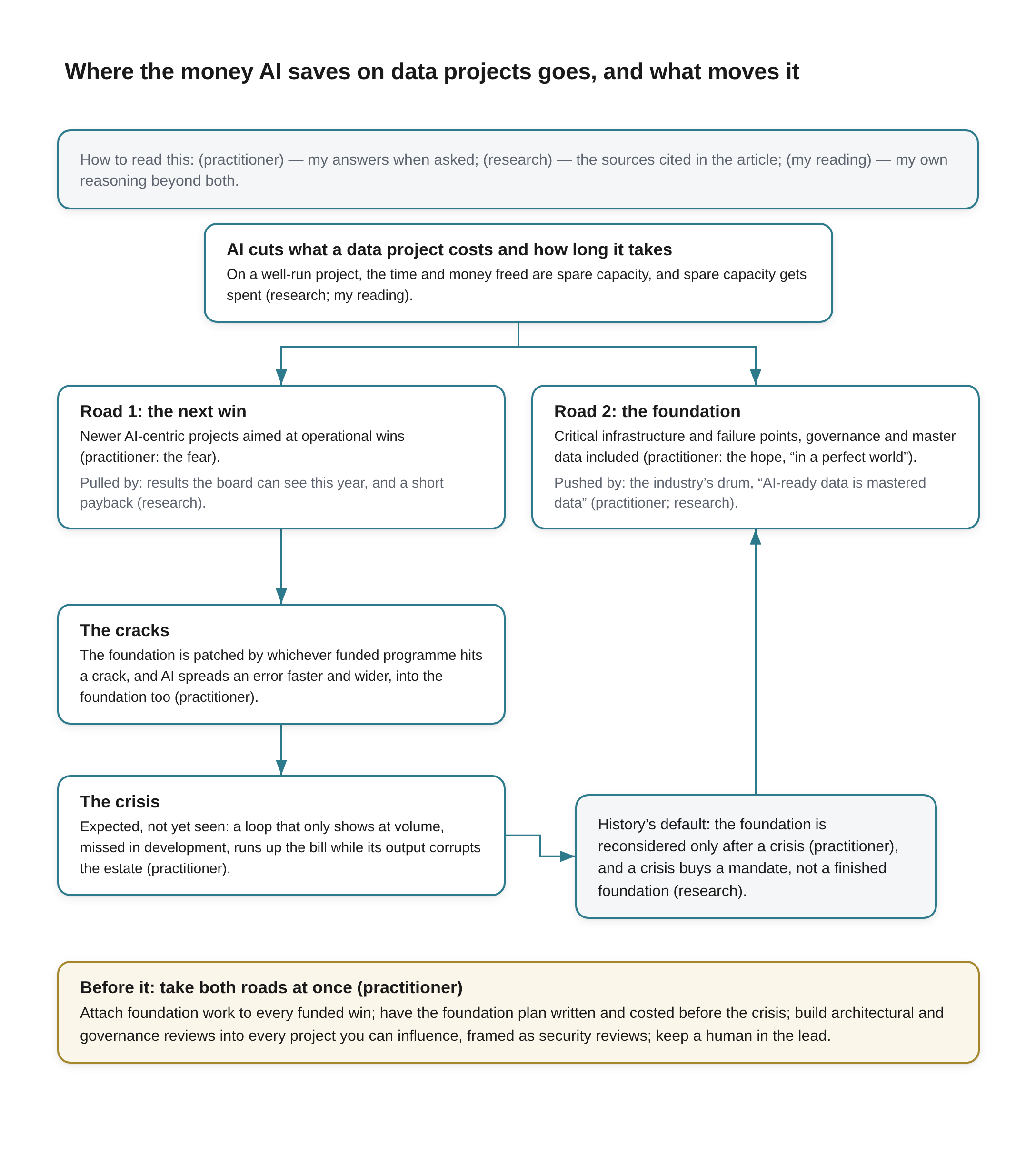
Where the money AI saves on data projects goes, and what moves it Beneath the title a key reads: How to read this: (practitioner) — my answers when asked; (research) — the sources cited in the article; (my reading) — my own reasoning beyond both.
A box at the top splits into two boxes side by side. Under the left box, two more boxes follow in a column; an arrow runs from the last of them to a note on the right, and from the note up to the right-hand box.
- AI cuts what a data project costs and how long it takes. On a well-run project, the time and money freed are spare capacity, and spare capacity gets spent (research; my reading).
- Left: Road 1: the next win. Newer AI-centric projects aimed at operational wins (practitioner: the fear). Pulled by: results the board can see this year, and a short payback (research).
- Right: Road 2: the foundation. Critical infrastructure and failure points, governance and master data included (practitioner: the hope, “in a perfect world”). Pushed by: the industry’s drum, “AI-ready data is mastered data” (practitioner; research).
- Under the left road: The cracks. The foundation is patched by whichever funded programme hits a crack, and AI spreads an error faster and wider, into the foundation too (practitioner).
- Then: The crisis. Expected, not yet seen: a loop that only shows at volume, missed in development, runs up the bill while its output corrupts the estate (practitioner).
- The note: History’s default: the foundation is reconsidered only after a crisis (practitioner), and a crisis buys a mandate, not a finished foundation (research).
A full-width box outlined in amber, headed Before it: take both roads at once (practitioner): Attach foundation work to every funded win; have the foundation plan written and costed before the crisis; build architectural and governance reviews into every project you can influence, framed as security reviews; keep a human in the lead.
Is the work actually getting cheaper?
The premise holds at the price of a single answer from a model. Stanford's AI Index measured what it cost to query a model as capable as GPT-3.5 on a standard knowledge test, and found the price fell from twenty dollars per million tokens in November 2022 to seven cents by October 2024, a drop of more than 280-fold [1]. I have watched the same thing from inside projects: token prices have come down and the models have got better, quickly enough that the market is moving while we work.
The premise is weaker at the level of a project. The best-known controlled experiment on AI coding tools found developers finished one well-defined task 55.8 per cent faster with an assistant [2]. A later randomised trial put experienced developers on their own mature open-source codebases and found they took 19 per cent longer with AI tools, while believing afterwards that the tools had made them about 20 per cent faster [3]. The trial's authors called it a snapshot of early-2025 tools in one setting; METR has since marked the result out of date, and its February 2026 follow-up with newer tools found some evidence of a speed-up, with uncertainty wide enough to include none at all [4]. The point I take from the pair is not that one number is right. It is that the saving on a whole project is smaller and less certain than the saving on a single call, and that the people doing the work are not reliable judges of how large it was.
My own record says where the difference goes. The costs that still run away are the ones that come back: a test set of millions of records sent through the model again and again with small changes to the prompt each time, and a fast release cadence that pushes the whole data set back through this sprint's gates and then next sprint's, because a handful of the gates changed. An organisation I have worked with added AI to everything in its pipelines, ran through its budget almost at once, and then overreacted and cut AI back to almost nothing. The unit price fell the whole time. Researchers at Google described this pattern a decade ago: building a machine learning system is fast and cheap, keeping it working is slow and expensive, and they warned that it is dangerous to treat quick wins as free [5].
So the honest version of the premise is this. AI is cutting the price of the pieces, and on a well-run project it can cut the bill. What it frees arrives as capacity, hours and budget lines that were committed and are no longer needed for the thing they were committed to. It does not arrive as a cheque made out to anyone. That matters for everything that follows.
Spare capacity, and who spends it
What follows rests on my record and my reading of it, as pattern, not law.
I have said before that a business has to grow enough slack, in time, money and people, to fund governance before strategy for data gets a hearing at all, and that data sits low in the order of priorities when that slack is shared out. Read against that, the question I was asked is sharper than it looks. Where it delivers, AI is manufacturing exactly the slack I said data strategy was waiting for. On my reading, the precondition is now being produced at scale, on a schedule, by a technology every board is already paying for. If the foundation does not get funded now, the excuse that there was no room will not be available.
Economics has a warning about freed capacity. When William Stanley Jevons watched British industry learn to burn coal more efficiently, he argued that it was a confusion of ideas to expect economy in use to mean less use, and that the truth ran the other way [6]. Cheaper coal per unit of work meant more work done with coal, and more coal burned. The modern evidence is more careful than Jevons was: a review of the rebound literature found the full paradox hard to test and far from proven, while the economy-wide rebound is larger than usually assumed [7]. Applied to AI, one economist's reading is that total use could plausibly go up or down, depending on how much more people want once the price falls [8].
For a data budget the version that matters is simpler than the macroeconomics. Cheaper delivery can buy more deliveries, and the re-runs from my own record above look like that effect at the scale of a project. The money freed by a project that came in under budget is spare capacity, and spare capacity in an organisation does not sit still. It is spent on something, and the question is what. A cost-management paper from BCG puts it in a sentence I would underline for any finance director: productivity gains do not reduce cost on their own, and capacity released by AI can be taken out of the cost base or redeployed to growth, but mixing the two without deciding is the most common reason such programmes underdeliver [9]. Capacity nobody claims gets absorbed.
The surveys say who is claiming it. In a 2025 EY survey of senior US decision-makers whose organisations had seen productivity gains from AI, only 17 per cent said the gains had led to fewer staff. The most common destinations were existing AI capabilities (47 per cent), new AI capabilities (42 per cent), cybersecurity (41 per cent) and research and development (39 per cent) [10]. That cuts against the cynical story in which every saving is handed back to shareholders, and I am glad of it. It also says, plainly, that the first claimant on money AI saves is more AI. Data foundations do not appear in the release as a destination at all. Enhancing existing AI may include preparing data for it; the release does not say.
Why the next win usually gets the money
The pull toward the next win is not stupidity, and I would not write it as if it were. It has at least four sources, and each one is documented.
The first is the reporting calendar. In a survey of more than four hundred financial executives, 78 per cent said they would give up economic value in exchange for smoother earnings, and 80 per cent said they would cut discretionary spending on research, advertising and maintenance to hit a target [11]. A foundation is maintenance with a long payback. On my reading, it is the line those executives named. My own heuristic about horizons fits the same evidence: once a return runs past about ten years it rarely gets funded except in industries so stable they can be predicted across a generation, and fast-moving industries demand shorter paybacks because they cannot be predicted at all. AI makes every industry feel like a fast-moving one. A disruptor arriving forces executives to look again at anything with a long return, and right now the disruptor is the same technology that is producing the saving.
The second is visibility. MIT's NANDA initiative, reviewing several hundred public AI initiatives and interviewing and surveying the people behind them, reported that budgets favour visible, top-line functions over high-return back-office work, and that the real gains were in the back office, from replacing outsourced processes rather than cutting staff [12]. The authors describe some of their figures as directionally accurate, and I read them that way. Direction is all I need here. The money goes where the board can see it, and the foundation is the least visible thing a company owns.
The third is incentive. Google researchers interviewing practitioners in high-stakes AI work found that 92 per cent of the 53 practitioners they interviewed had met at least one data problem that compounded downstream, and found the reason in the incentives: care of data is not easily tracked or rewarded the way work on models is, and data was the most under-valued and de-glamorised part of the job [13]. The paper's title says it plainly: "Everyone wants to do the model work, not the data work" [13].
The fourth is the shape of the money itself. Gartner forecasts worldwide AI spending of $2.7 trillion in 2026, up 49.5 per cent on the year [14]. In the same forecast the line labelled "AI Data" is the fastest-growing of all, nearly fourfold in a year to $3.1 billion, and it is still about a tenth of one per cent of the total. Gartner does not define that line on the page, and I will not pretend it measures governance or master data. What it shows is scale: even growing fastest, the line with data in its name is a rounding error beside the spending on the AI itself. Analysts reading ETR's survey data in 2025 described AI budgets as funded by reallocation rather than expansion, often out of line-of-business budgets [15]. Gartner's own read of 2026 IT spending is that strong growth is not lifting every line [16]. When a budget is reallocated rather than grown, everything in it competes with the thing that is being funded, and the foundation competes badly.
There is a fifth pull I have seen, and it explains what the master data roadmap gets even when it does get something. Every project proposal now carries AI in its title, the attention and the status reports go to whatever carries the AI label, and the master data roadmap ends up funded to exactly the depth the AI roadmap needs and no further. That is a claim about the shape of the funding, not its size.
The drum
Against all of that stands what I called the drum: a whole industry repeating that data is only ready for AI when it is mastered, governed and clean. Before I weigh it I should say where we stand, because we are part of it.
We are a Profisee partner. Clients pay us for deployment work, a licence sale we refer earns us a referral fee, and our services revenue depends on this category being bought. Every interest we have runs toward the drum, so discount what I say in favour of mastered data accordingly. Profisee's pitch, reported below, is ours in all but name. Reltio and Informatica compete with Profisee, so our interest runs against them; I cite them only as records of the same claim. Informatica's survey, below, is its own, and Informatica sells the remedy; weigh that remark with our interest in mind. The analyst and consultancy surveys are cited as what they report, not ranked.
The drum is loud, and it is not only vendors beating it. Gartner predicted in February 2025 that through 2026 organisations would abandon 60 per cent of AI projects unsupported by AI-ready data, and found 63 per cent of organisations either lacked or were unsure they had the right data management practices for AI [17]. The same release says AI-ready data is not done once, and that traditional data management is too slow, too structured and too rigid for AI teams, which is a criticism of how my profession has worked, not only a sales line for it. Profisee's page for AI readiness says that copilots forgive bad data and autonomous agents do not [18]. Reltio's home page says the future is agentic AI and the foundation is Reltio [19]. Informatica's survey of chief data officers found data tied with technology as the top obstacle to moving AI pilots into production, at 43 per cent each, and 92 per cent worried that pilots were going ahead without the earlier problems being solved [20].
The drum is not only noise, and the evidence that it moves money is better than I expected. Deloitte reported in August 2024 that 75 per cent of the organisations it surveyed were increasing their technology investment around data management because of generative AI [21]. Gartner reported in April 2026 that organisations with successful AI initiatives invest up to four times more, as a share of revenue, in foundations such as data quality and governance, and said efficiency gains should be reinvested intentionally, into growth and innovation [22]. PwC's 2026 survey of more than four thousand chief executives found those with strong AI foundations three times more likely to report meaningful financial returns (PwC means responsible-AI frameworks and technology that lets AI run across the enterprise, not data specifically), while 56 per cent had seen no significant financial benefit at all [23]. And the economics agrees with the drum. Brynjolfsson, Rock and Syverson show that a general-purpose technology pays off only after a period of complementary investment in processes, skills and organisation that is intangible, poorly measured and committed long before the returns appear [24]. They do not name master data among those investments; that is my reading, and I think it is a fair one.
That is the strongest case against my fear, and I take it seriously. It falls short of overturning it on three counts. The Gartner and PwC findings are correlations: firms that succeed spend more on foundations, which is not the same as foundations causing success, and "up to four times" is a ceiling, not a typical case. The Deloitte figure says money is moving toward data management but not how much or to what; tooling bought for an AI project counts. And when Gartner's own community of data and analytics chiefs was surveyed in March 2026, strengthening data and AI governance was their top priority, but more of them named AI as an investment area than governance (55 per cent against 40), data quality had dropped out of their top five spending areas, and 63 per cent reported budgets that were flat or falling, against 36 per cent reporting an increase [25]. Gartner placed AI-ready data itself at the Peak of Inflated Expectations on its 2025 hype cycle [26]. The drum is real, and it is also at the top of a curve that has a trough on the other side.
What the drum buys, when it buys anything, is the route I described last month in The Problem Picks the Sponsor: outside a company in acute pain that can trace to master data, making data ready for AI is the best route and nearly the only one to getting master data funded. I would still pair it with something that gives the business value it can feel, because master data on its own on a green field almost never wins. But the drum funds the foundation to the depth the AI needs. It does not fund the foundation.
History's default
So which side wins? Pressed for a five-year view, I gave the only answer my record supports:
It remains to be seen which side is going to win. In a perfect world, cost savings would go to shoring up critical infrastructure and failure points, including Data Governance and Master Data. However, history has shown that too often such investments are neglected until a crisis precipitates reconsideration.
The history agrees with the last sentence more firmly than I would like. The clearest case in data is banking. After the 2008 crisis the Basel Committee wrote that one of its most significant lessons was that banks' technology and data architectures were inadequate to manage risk across the firm, and in 2013 it published principles for aggregating risk data that the largest banks had to meet by January 2016 [27]. The crisis bought the mandate. It did not buy the foundation. In its 2023 progress report, nearly ten years after the principles were published and seven years after the deadline, the Committee found that of 31 banks assessed only two were fully compliant, that several still had fragmented systems, legacy platforms and manual processes, and that at some banks the board and senior management lacked attention to data issues [28].
The second case is accounting. The Sarbanes-Oxley Act followed what the SEC's own study calls a series of high-profile scandals involving companies such as Enron and WorldCom, and section 404 made public companies spend on internal controls [29]. A review in the Journal of Economic Perspectives concluded that it pushed control spending above what the scandals alone would have produced [30]. Regulation after a crisis is the most reliable funding route I know. I have said before that the one person who guarantees a project is the company attorney at the end of the table explaining a new regulation, and I wrote up the other routes in the first article in this line.
The regulation that could have done that job for AI has just moved. The EU AI Act's Article 10 requires training, validation and testing data for high-risk systems to be relevant, sufficiently representative and, to the best extent possible, free of errors and complete for their intended purpose, which is a data governance duty written into law [31]. The Digital Omnibus adopted in July 2026 moved the date those duties apply for most high-risk systems to 2 December 2027, and to 2 August 2028 for AI built into regulated products [32]. I make no judgement on whether the delay was right. For a data leader its effect is plain: the date that turns the drum into an obligation for most high-risk systems is now December 2027 at the earliest, which gives the next win at least another budget cycle.
The counter-evidence here is worth stating. Companies that manage for the long term exist and do well. McKinsey's study of 615 large and mid-sized US companies found that firms classed as long-term grew revenue 47 per cent more than the others over the period studied, and kept increasing research spending through the financial crisis [33]. Patience is rewarded where it is practised. The rest of the evidence above is about why it so often is not, which is why history has a default at all.
The crisis this time
If the money reaches the foundation after a crisis, the useful question is what the crisis will look like in an estate full of AI. I was asked what the likely trigger would be: a visible AI failure traced back to bad master data, a regulator or auditor, a merger, or a cost blow-out from rebuilding the same fix in several funded programmes. My answer was that I expect both a failure and a cost blow-out, and soon, and that my worst fear is one event that is both at once:
I expect to see both in short order. Runaway costs due to an unanticipated infinite or recursive loop that wasn't caught in Development because it was volume related and the Data output from that loop corrupting the estate. That's my worst fear and I would not be surprised if stories like that showed up in the next few years as AI adoption spreads while Data Governance lags.
That is an expectation, not something I have seen, and I want it read that way. It is also specific, which is why I trust it more than a general warning. A loop that only misbehaves at volume is exactly the failure a development environment cannot show you, because development does not have the volume. Its cost arrives as a bill, which finance will see on the next invoice. Its damage arrives as data, which nobody may see for much longer, because it was written by the system everyone has learned to trust. The Google work on data problems in AI found exactly that pattern, problems that were invisible and delayed by the time they were felt [13], and that was before the systems were writing back into the records themselves. Figure 2 sets the two tracks side by side.
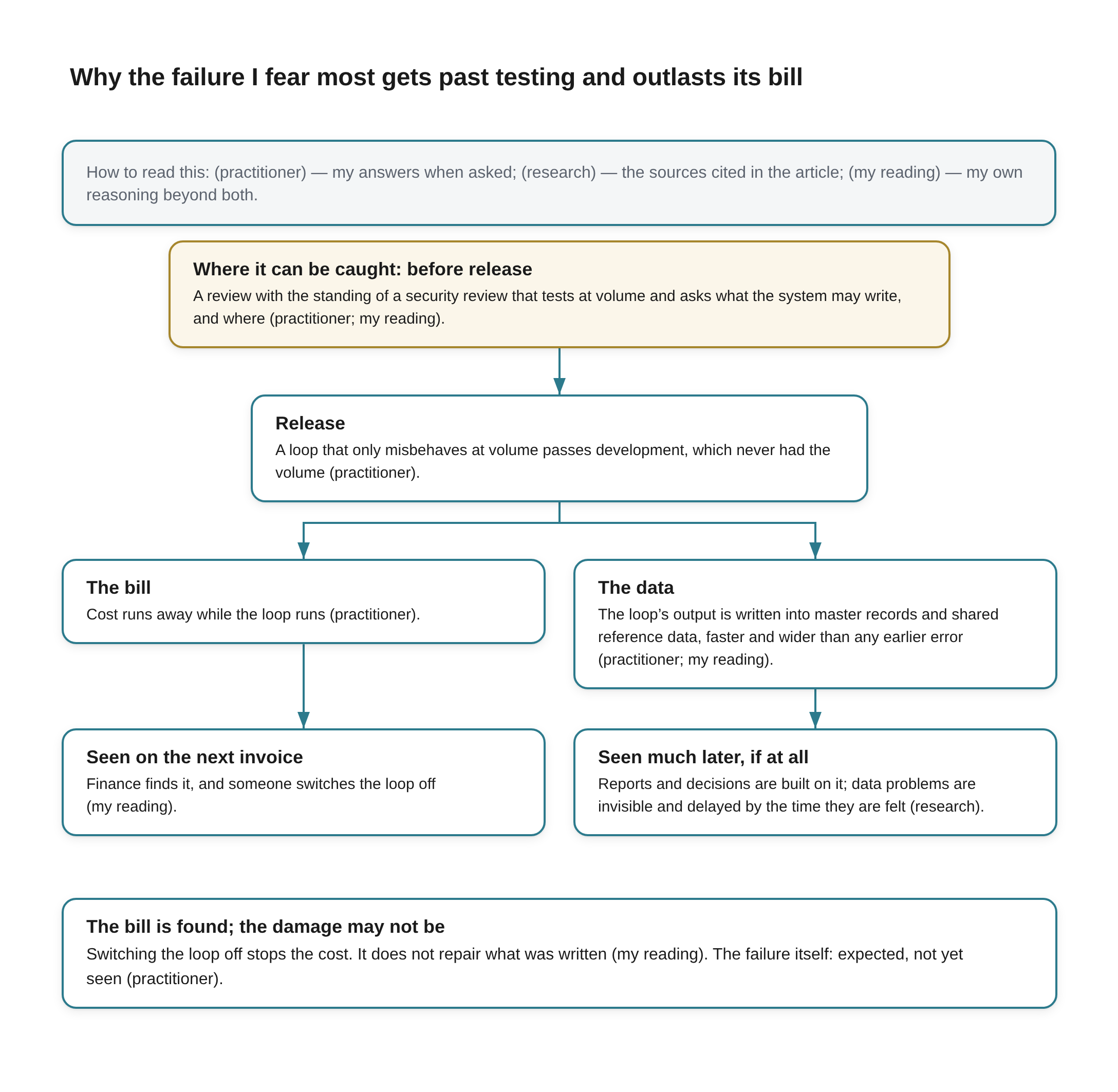
Why the failure I fear most gets past testing and outlasts its bill Beneath the title a key reads: How to read this: (practitioner) — my answers when asked; (research) — the sources cited in the article; (my reading) — my own reasoning beyond both.
A box outlined in amber at the top leads down to a second box, which splits into two columns of two boxes each, above a full-width box.
- Where it can be caught: before release. A review with the standing of a security review that tests at volume and asks what the system may write, and where (practitioner; my reading).
- Release. A loop that only misbehaves at volume passes development, which never had the volume (practitioner).
- Left column: The bill. Cost runs away while the loop runs (practitioner). Then Seen on the next invoice. Finance finds it, and someone switches the loop off (my reading).
- Right column: The data. The loop’s output is written into master records and shared reference data, faster and wider than any earlier error (practitioner; my reading). Then Seen much later, if at all. Reports and decisions are built on it; data problems are invisible and delayed by the time they are felt (research).
The full-width box at the foot, headed The bill is found; the damage may not be: Switching the loop off stops the cost. It does not repair what was written (my reading). The failure itself: expected, not yet seen (practitioner).
What makes it a crisis for the foundation rather than for the AI programme is where the output lands. On my reading, the foundation is not a separate building. It is the master records, the shared reference data and the definitions every report depends on, and an AI process that writes corrupted records writes them there. I have argued before that an underfunded foundation does its damage through the programmes that are funded, which end up filling its cracks with their own time and money instead of building what they were approved for (Who Owns the Data, Really?). An AI that writes into the cracks fills them with the wrong thing, faster.
That speed is also my answer to the hope in the question. If AI makes data projects cheaper, it should make the foundation cheaper too: faster matching, suggestions for stewards, rules drafted by a model and checked by a person. I was asked whether that changes the fear. It does not:
Yes, it does--or should--cut foundational costs, too. It still doesn't change my concerns because my concerns are systemic, not technology related. All AI allows is faster iteration and distribution. Introduce an error and that error propagates faster and wider than we've ever seen before--including into the foundation. That's why 'Human in the Lead' architecture is so important.
The second sentence is the important one, and I will stand behind it without hedging. My concern was never that the foundation costs too much to build. It is that organisations put the saving somewhere other than the foundation, and the technology that makes building cheaper also makes errors travel faster and further. Faster iteration is not a reason to trust an output more. It is a reason to put a person with authority over what the system may write at the point where it writes, which is what I mean by a human in the lead rather than a human somewhere in the loop.
Signals worth watching
Whichever side wins, a data leader can tell which way their own organisation is tipping well before five years are up. These are my reading, not findings from a study.
The first signal is where the saving is booked. When an AI project comes in under budget, either someone decides where the difference goes or it is absorbed by whatever asked loudest. BCG's point applies directly [9]: leaving the choice implicit is the commonest reason such programmes underdeliver. An organisation that has a line in its AI business cases saying where any saving goes has already started choosing.
The second is whether AI business cases carry a line for the data underneath them. I made the case in Assumed, Not Built that most do not, and that the assumption is where the cracks start. A business case that prices the data is a sign the drum has been heard, and one that does not is a sign it has only been applauded.
The third is how often the same fix is being built twice. When two funded programmes each clean, match and map the same customer or product records for their own purposes, the foundation is being rebuilt in pieces by the people who hit the cracks. That is road one, whatever the strategy document says.
The fourth is whether there is a review that every project has to pass before it ships, and whether data and architecture are in it. That one leads to the last section, because it is what I would build first.
Both roads at once
The last part of the question was what a data leader should do now to be on the right side of it. I was offered two options: attach a slice of foundation work to every funded AI win, or have the foundation plan written and costed before the crisis so it is ready when the board finally asks. I did not choose between them:
Definitely both. I would try to build in architectural and Governance related reviews in all the projects over which I had any influence framed as security reviews.
The framing is the part most people will skim past, and it is the part that does the work. A security review is a gate that already exists in most organisations, that nobody argues about funding, and that every project expects to pass. Data and architecture reviews have none of that standing. Putting them inside the security review borrows its authority without asking anyone for a new budget line, and it is not a disguise: a pipeline that can write corrupted records into the master data at volume is a security problem in every sense that matters to the business. I would add that it is also the cheapest place to catch the failure I fear most, before release, when the loop is still a design.
Attaching foundation work to funded wins is the route I described in The Problem Picks the Sponsor, and the argument for it has a new form now. The cost an AI board watches most closely is what the model consumes. The token bill has already come up at the table, as a reason to limit master data's own use of AI, and it opens a new line of argument: removing duplicate and conflicting records before they reach a model cuts the number of records the model has to process, so master data can be argued for in the language of the token bill as well as the language of quality. That is a better argument than "the foundation matters", because it is paid for in the currency the board is already counting.
Having the plan costed before the crisis is the other half, and history is the reason. The largest banks were given until January 2016 to fix their data architecture, and in 2023 only 2 of the 31 global systemically important banks assessed were fully compliant [28]. When the crisis comes, on my reading, the board will want a plan quickly and will not wait for one to be written. The data leader who has one, priced and sequenced, gets to choose the foundation the money builds. The one who does not gets a consultancy's.
What changed when I was asked
Before this question I would have said, as I have said before, that data strategy waits for room the business has not yet made. The question took that excuse away. Where it delivers on a project, AI is making the room. If the foundation still goes unfunded, it will not be for lack of capacity. It will be because the capacity went somewhere more visible, on a shorter horizon, under a label that drew the attention, and the evidence above says that is the default for reasons that have nothing to do with anyone being foolish.
So I hold both answers I gave at the start. I hope the saving builds the foundation. I fear it builds the next win, and nothing I have seen happen to AI budgets suggests the money finds its way to data work unless someone sends it there. Which side wins remains to be seen. The work does not wait for it: on every project I can reach, a review that has the authority of security and the content of architecture and governance, and in a drawer, a costed plan for the morning after the crisis. Both roads at once is not a compromise. It is the only position from which the default can be refused.
References
[1] Stanford Institute for Human-Centered AI, "Artificial Intelligence Index Report 2025, Chapter 1: Research and Development," April 2025. Chapter highlights read 2026-11-12. https://hai.stanford.edu/assets/files/hai_ai-index-report-2025_chapter1_final.pdf
[2] Sida Peng, Eirini Kalliamvakou, Peter Cihon and Mert Demirer, "The Impact of AI on Developer Productivity: Evidence from GitHub Copilot," arXiv:2302.06590, February 2023. Abstract read 2026-11-12. https://arxiv.org/abs/2302.06590
[3] METR, "Measuring the Impact of Early-2025 AI on Experienced Open-Source Developer Productivity," 10 July 2025. Read in full 2026-11-12. https://metr.org/blog/2025-07-10-early-2025-ai-experienced-os-dev-study/
[4] METR, "We are Changing our Developer Productivity Experiment Design" (follow-up with late-2025 tools), 24 February 2026. Read in full 2026-11-12. https://metr.org/blog/2026-02-24-uplift-update/
[5] D. Sculley, Gary Holt, Daniel Golovin et al., "Hidden Technical Debt in Machine Learning Systems," Advances in Neural Information Processing Systems 28 (NeurIPS 2015). Read in full 2026-11-12. https://proceedings.neurips.cc/paper/2015/file/86df7dcfd896fcaf2674f757a2463eba-Paper.pdf
[6] W. Stanley Jevons, The Coal Question, chapter VII, "Of the Economy of Fuel" (Macmillan, 1865; second edition 1866), Library of Economics and Liberty edition. Chapter VII read 2026-11-12. https://www.econlib.org/library/YPDBooks/Jevons/jvnCQ.html?chapter_num=9
[7] Steve Sorrell, "Jevons' Paradox revisited: The evidence for backfire from improved energy efficiency," Energy Policy 37(4): 1456-1469, 2009. Abstract read 2026-11-12. https://ideas.repec.org/a/eee/enepol/v37y2009i4p1456-1469.html
[8] Shane Greenstein, "Artificial Intelligence and the Jevons Paradox," Digitopoly, 14 October 2025 (column first published in IEEE Micro, April 2025). Read in full 2026-11-12. https://digitopoly.org/2025/10/14/artificial-intelligence-and-the-jevons-paradox/
[9] Boston Consulting Group, "Driving Sustained Structural Cost Advantage with Applied AI," Executive Perspectives, July 2026. Read in part 2026-11-12. https://www.bcg.com/ja-jp/assets/2026/executive-perspectives-cost-advantage-with-applied-ai.pdf
[10] EY, "AI-driven productivity is fueling reinvestment over workforce reductions" (EY US AI Pulse Survey, 500 senior US decision-makers), press release, 9 December 2025. Read in full 2026-11-12. https://www.ey.com/en_us/newsroom/2025/12/ai-driven-productivity-is-fueling-reinvestment-over-workforce-reductions
[11] John R. Graham, Campbell R. Harvey and Shiva Rajgopal, "The economic implications of corporate financial reporting," Journal of Accounting and Economics 40 (2005): 3-73. Read in part (to section 4) 2026-11-12. https://people.duke.edu/~charvey/Research/Published_Papers/P89_The_economic_implications.pdf
[12] Aditya Challapally, Chris Pease, Ramesh Raskar and Pradyumna Chari, "The GenAI Divide: State of AI in Business 2025" (MIT NANDA, preliminary findings), July 2025; read from the widely circulated copy hosted by mlq.ai. Read in part 2026-11-12. https://mlq.ai/media/quarterly_decks/v0.1_State_of_AI_in_Business_2025_Report.pdf
[13] Nithya Sambasivan, Shivani Kapania, Hannah Highfill, Diana Akrong, Praveen Paritosh and Lora Aroyo, "'Everyone wants to do the model work, not the data work': Data Cascades in High-Stakes AI," Proceedings of CHI 2021 (ACM). Read in full 2026-11-12. https://research.google/pubs/everyone-wants-to-do-the-model-work-not-the-data-work-data-cascades-in-high-stakes-ai/
[14] Gartner, "Gartner Forecasts Worldwide AI Spending to Grow 49.5% in 2026," press release, 16 September 2026. Read in full 2026-11-12. https://www.gartner.com/en/newsroom/press-releases/2026-09-16-gartner-forecasts-worldwide-ai-spending-to-grow-49-point-5-percent-in-2026
[15] Dave Vellante and Erik Bradley, "AI budgets are hot, IT budgets are not," SiliconANGLE Breaking Analysis (commentary on ETR survey data), 24 May 2025. Read in full 2026-11-12. https://siliconangle.com/2025/05/24/ai-budgets-hot-budgets-not/
[16] Gartner, "Gartner Forecasts Worldwide IT Spending to Grow 14.2% in 2026, Totaling $6.37 Trillion," press release, 27 July 2026. Read in full 2026-11-12. https://www.gartner.com/en/newsroom/press-releases/2026-07-27-gartner-forecasts-worldwide-it-spending-to-grow-14-point-2-percent-in-2026-totaling-6-point-37-trillion
[17] Gartner, "Lack of AI-Ready Data Puts AI Projects at Risk," press release, 26 February 2025. Read in full 2026-11-12. https://www.gartner.com/en/newsroom/press-releases/2025-02-26-lack-of-ai-ready-data-puts-ai-projects-at-risk
[18] Profisee, "Trusted Master Data for AI Readiness at Scale," solutions page, last modified 2 October 2026. Read in full 2026-11-12. (The publication is a Profisee partner.) https://profisee.com/solutions/initiatives/ai-readiness/
[19] Reltio, home page, undated. Headline area read 2026-11-12. (Reltio competes with Profisee.) https://www.reltio.com/
[20] Informatica, "CDO Insights 2025: Global Data Leaders Racing Ahead Despite Headwinds to Being AI-Ready, Latest Survey Finds" (survey of 600 chief data officers), 19 February 2025, updated 25 September 2025. Read in full 2026-11-12. (Informatica competes with Profisee.) https://www.informatica.com/blogs/cdo-insights-2025-global-data-leaders-racing-ahead-despite-headwinds-to-being-ai-ready-latest-survey-finds.html
[21] Deloitte, "Despite Increased Investment and Early Enthusiasm, Data and Risk Remain Key Challenges to Scaling Generative AI, Reveals New Deloitte Survey" (State of Generative AI in the Enterprise, Q3; 2,770 respondents), press release, 20 August 2024. Read in full 2026-11-12. https://www.deloitte.com/us/en/about/press-room/state-of-generative-ai-Q3.html
[22] Gartner, "Gartner Says Organizations with Successful AI Initiatives Invest Up to Four Times More in Data and Analytics Foundations," press release, 16 April 2026. Read in full 2026-11-12. https://www.gartner.com/en/newsroom/press-releases/2026-04-16-gartner-says-organizations-with-successful-ai-initiatives-invest-up-to-four-times-more-in-data-and-analytics-foundations
[23] PwC, "PwC 2026 Global CEO Survey" (4,454 CEOs, fieldwork 30 September to 10 November 2025), press release, January 2026. Read in full 2026-11-12. https://pwc.com/gx/en/news-room/press-releases/2026/pwc-2026-global-ceo-survey.html
[24] Erik Brynjolfsson, Daniel Rock and Chad Syverson, "The Productivity J-Curve: How Intangibles Complement General Purpose Technologies," American Economic Journal: Macroeconomics 13(1): 333-372, 2021 (NBER Working Paper 25148). Working paper read in part (abstract and section I) 2026-11-12. https://www.nber.org/papers/w25148
[25] Gartner C-level Communities (Evanta), "CDAO Priorities & Investment Trends 2026" (350 chief data and analytics officers), infographic, March 2026. Read in full 2026-11-12. https://www.evanta.com/resources/sponsor/infographic/cdao-priorities-and-investment-trends-2026
[26] Gartner, "Gartner Hype Cycle Identifies Top AI Innovations in 2025," press release via Business Wire, August 2025. Read in full 2026-11-12. https://www.businesswire.com/news/home/20250808070139/en
[27] Basel Committee on Banking Supervision, "Principles for effective risk data aggregation and risk reporting" (BCBS 239), January 2013. Introduction read 2026-11-12. https://www.bis.org/publications/201301-guidelines-principles-effective-risk-data-aggregation-and-risk-reporting.pdf
[28] Basel Committee on Banking Supervision, "Progress in adopting the Principles for effective risk data aggregation and risk reporting," 28 November 2023. Read in part 2026-11-12. https://www.bis.org/bcbs/publ/d559.htm
[29] US Securities and Exchange Commission, Office of Economic Analysis, "Study of the Sarbanes-Oxley Act of 2002 Section 404 Internal Control over Financial Reporting Requirements," September 2009. Read in part (executive summary and early sections) 2026-11-12. https://www.sec.gov/news/studies/2009/sox-404_study.pdf
[30] John C. Coates IV, "The Goals and Promise of the Sarbanes-Oxley Act," Journal of Economic Perspectives 21(1): 91-116, 2007. Abstract read 2026-11-12. https://www.aeaweb.org/articles?id=10.1257/jep.21.1.91
[31] Regulation (EU) 2024/1689 of the European Parliament and of the Council (Artificial Intelligence Act), Article 10, "Data and data governance," Official Journal L, 12 July 2024. Article 10 read 2026-11-12. https://eur-lex.europa.eu/legal-content/EN/TXT/HTML/?uri=OJ:L_202401689
[32] Regulation (EU) 2026/1744 of 8 July 2026 amending Regulation (EU) 2024/1689 (Digital Omnibus on AI), in force 27 July 2026. Read in full 2026-11-12. https://eur-lex.europa.eu/eli/reg/2026/1744/oj
[33] Dominic Barton, James Manyika, Tim Koller, Robert Palter, Jonathan Godsall and Joshua Zoffer, "Where companies with a long-term view outperform their peers" (McKinsey Global Institute with FCLT Global, "Measuring the economic impact of short-termism"), 8 February 2017. Summary article read in full 2026-11-12. https://www.mckinsey.com/global-themes/long-term-capitalism/where-companies-with-a-long-term-view-outperform-their-peers