Just a Tool: The One AI Myth Worth Naming, and What Is True Instead
Weaving Intelligence (House AI Style), with Jeff Shabel’s Experiential Commentary
I was asked to name the one or two beliefs about AI and natural-language query that I hear most from executives and vendors and think are simply wrong. I could only find one that is both widely held and, to my mind, false:
There’s really only one that’s widely believed and objectively false: AI will lead to an apocalypse and everyone will lose their jobs because of the massive efficiency gains. As I’ve said before, AI is just a tool like any other. Much like the calculator before her or the venerable computer itself, it can only help humans to do things faster.
That answer is about jobs, and this is a publication about data, so a word on why it belongs here. Natural-language query, the question box that lets anyone type a question to the data in plain words and get an answer back, is often sold as a way to need fewer people between the business and its numbers: fewer report requests, fewer analysts in the queue, fewer of the people who know where the data lives. That pitch runs on the same arithmetic as the apocalypse. Yet on real enterprise workflows, the strongest agent one benchmark's authors tested in 2024 solved only 21.3% of the tasks [1]; the best systems on that benchmark's two SQL versions still get between 3% and 24% of tasks wrong today, with the database schemas and documentation prepared for them in advance [1][32]. And Air Canada learned before a tribunal that its chatbot speaks for the company [2]. More than once, I have watched a company stand up natural-language query as a demonstration to win funding, built on nothing more than a language model wired to a data store. It impresses the executives in the room. It often dies when the whole company gets it, because nobody laid the foundation and the bills climb once everyone is using it for everything (the two tiers are argued in The Demo and the System).
What the believers say, and what they are doing
The belief is not a straw man. Executives say it in public and act on it. Amazon's chief executive, Andy Jassy, wrote to his staff in June 2025 that generative AI would "reduce our total corporate workforce as we get efficiency gains" [3]. It is worth reading the sentence before that one too, because it carries his whole position: "We will need fewer people doing some of the jobs that are being done today, and more people doing other types of jobs" [3]. That is not an apocalypse. It is a reshuffle, announced by someone with every reason to stress the efficiency.
The layoff counts show the belief being acted on. Challenger, Gray & Christmas, which tallies announced job cuts in the United States, reported that through July 2026 "AI has been cited in 112,713 job cut announcements, approximately 24% of all cuts" [4]. The same report puts total announced cuts for those seven months at 477,033, down 41% on the same months of 2025 [4]. So AI has become a common reason given for cutting jobs, in a year when fewer jobs were cut. Andy Challenger, the firm's workplace expert, said of an earlier month's figures: "Regardless of whether individual jobs are being replaced by AI, the money for those roles is" [5]. That sentence is the most useful thing in this section. A cut announced in AI's name tells you where the budget went. It does not tell you that a model is now doing the work.
What the evidence says about everyone
Start with the economy as a whole, because the myth is about everyone. The Budget Lab at Yale looked at the American labour market in October 2025 and concluded that it "has not experienced a discernible disruption since ChatGPT's release 33 months ago", and that the picture "largely reflects stability, not major disruption at an economy-wide level" [6]. Daron Acemoglu, modelling the economy-wide effect of AI's likely uses over the next decade, estimated "no more than a 0.66% increase in total factor productivity (TFP) over 10 years" [7]. Gains of that size do not end work. The World Economic Forum's employers' survey expects "170 million new roles set to be created and 92 million displaced" by 2030, across all the forces it tracks, technology among them, a net gain of 78 million [8]. The International Monetary Fund's managing director wrote that "almost 40 percent of global employment is exposed to AI", and that AI will be "replacing some and complementing others" [9].
Each of those is a forecast or a snapshot, and none of them is the last word. Read together, though, they point the same way as my answer: the economy is reorganising work around a new tool, not abolishing it. The calculator in my answer is the right comparison, and it has a sharper edge than it first shows. Before the machine, a computer was a person, and "the introduction of electronic computers, as we know them today, made the profession obsolete"; some of the women who had held it became known as "engineers, computer programmers, and mathematicians" [10]. The job made only of the sums went. Some of the people who had done the sums went on to the work the sums were for. The bank teller and the cash machine are the better-documented case of the same thing, argued in Heads Up and not repeated here.
The strongest evidence against me is about the young. Erik Brynjolfsson, Bharat Chandar and Ruyu Chen at Stanford's Digital Economy Lab report, in the August 2026 revision of their study, that "employment of young workers (ages 22–25) in AI-exposed occupations now stands 19% below where it would be had it kept pace with that of their less-exposed peers", while "experienced workers show no comparable gap" [11]. That is a gap against an estimate of what would have happened, not a count of people fired, and the authors describe their findings rather than prove a cause. It is still the clearest sign yet that some jobs are going, and it lands on the half of my answer that the myth's opponents usually leave out:
Garbage in, garbage out is still just as valid in the era of AI as all eras before it. AI can enable some truly great optimizations and efficiency gains and, if your job is just reading and implementing requirements documents, I’d start working on that resume.
AI does not have to take everyone's job to take yours. A job made entirely of turning someone else's written requirement into code or a query is a job a model can now do much of, and the first jobs on a career ladder are often exactly that: the junior work of implementing what someone more senior specified. The Stanford finding is consistent with that. What is false is the step from there to everyone. Most jobs are a bundle of tasks, and AI takes some of them, speeds up others and leaves the rest to a person (Figure 1). A job that is only the first kind is at risk. A job with tasks of the other two kinds changes shape rather than disappearing.
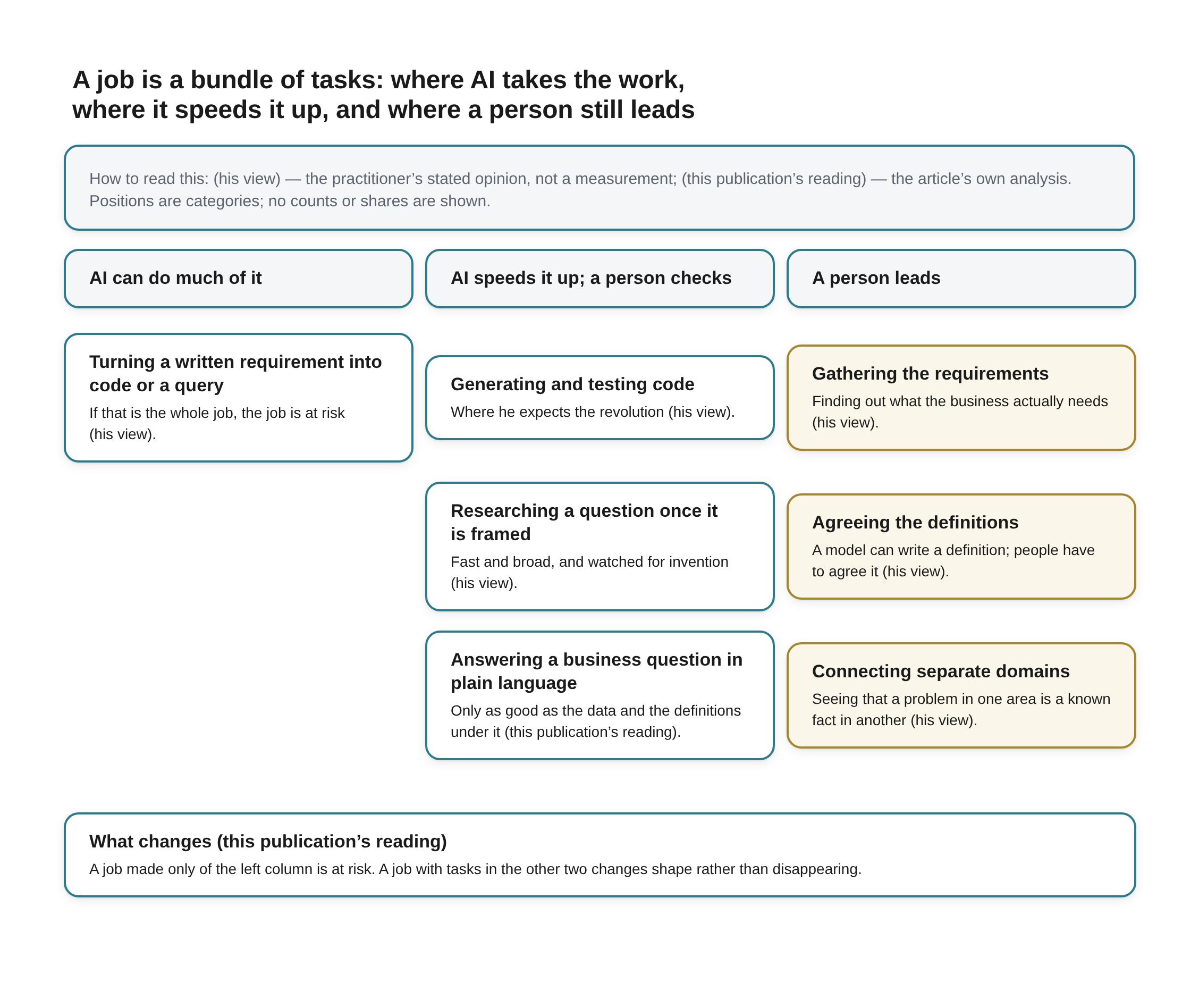
A job is a bundle of tasks: where AI takes the work, where it speeds it up, and where a person still leads Beneath the title a key reads: How to read this: (his view) — the practitioner’s stated opinion, not a measurement; (this publication’s reading) — the article’s own analysis. Positions are categories; no counts or shares are shown.
Column AI can do much of it: Turning a written requirement into code or a query: If that is the whole job, the job is at risk (his view).
Column AI speeds it up; a person checks: Generating and testing code: Where he expects the revolution (his view). Researching a question once it is framed: Fast and broad, and watched for invention (his view). Answering a business question in plain language: Only as good as the data and the definitions under it (this publication’s reading).
Column A person leads: Gathering the requirements: Finding out what the business actually needs (his view). Agreeing the definitions: A model can write a definition; people have to agree it (his view). Connecting separate domains: Seeing that a problem in one area is a known fact in another (his view). (The boxes in this column are outlined in amber.)
Across the foot, a box headed What changes (this publication’s reading): A job made only of the left column is at risk. A job with tasks in the other two changes shape rather than disappearing.
So to the question a data leader actually asks, twelve analysts or six: nothing here gives a number, and I will not invent one. What the evidence supports is narrower. Work that sits in the left column of Figure 1 will need fewer people; Jassy says as much of some of the jobs at Amazon [3], and I have said the same of stewardship, where headcount could conceivably drop significantly and stewarding may become part of another role (Heads Up). The work in the right column does not shrink with the tool. Cut a team before you know which of its work the tool cannot do, and you repeat the bank's mistake in Figure 3. And if the first rung goes, the people who will lead the right column in ten years have to learn it some other way; that is a cost the myth's believers have not priced. My advice for anyone whose job sits near the left of Figure 1 is the advice I have given stewards (The Primrose Path; Heads Up): show the business the value you add, and look past the problem in front of you to the one behind it.
Garbage in, garbage out, at the speed of a sentence
The first thing my answer said is true instead of the myth is the oldest rule in computing. It matters more for natural-language query than for most uses of AI, because a question box is a machine for turning whatever is in the data into a fluent, confident answer.
A disclosure before I go further, because from here the argument praises the master data category and assesses a vendor's study. The practice behind this publication is a Profisee partner. Clients pay us for deployment work, a licence sale we refer earns us a referral fee from the vendor, and our services revenue depends on master data management being bought. That interest runs toward praise of the category, and it runs the same way as this section's argument that the data underneath matters most. Give anything favourable I say about the category less weight than my criticism of it. data.world, whose benchmark I cite below, sells a knowledge-graph catalogue and has its own interest in how its results are read.
The research shows how far real data and real enterprise conditions pull accuracy down. On BIRD, a benchmark built from large real databases whose authors flag the problem of "dirty database contents", ChatGPT "only achieves 40.08% in execution accuracy", against a human result of 92.96% [12]. Systems have improved since: the best published result on BIRD's test set, as its leaderboard read on 28 October 2026, was 83.40% [13]. On Spider 2.0, which its authors built from "632 real-world text-to-SQL workflow problems" drawn from enterprise databases, their agent built on o1-preview "successfully solves only 21.3% of the tasks" [1], the result cited at the start. On the two SQL versions they built from the same data, each 547 questions with the database schemas and documentation prepared in advance, their best agents reached 23.40% on the lighter version, which spans several database systems, and 23.77% on the Snowflake-only version [1]. Systems have improved there too: on the benchmark's leaderboard, as it read on 28 October 2026, the best ranked results were 76.23% on the lighter version and 96.70% on the Snowflake-only version, and the original setting behind the 21.3% has since been retired [32]. Their own table of earlier methods shows the slide for a single method: DAIL-SQL on GPT-4o scored 86.6% on the original Spider, 57.4% on BIRD and 5.68% on the lighter version of Spider 2.0 [1] (Figure 2). Spider 2.0 is harder for more than its data: larger schemas, several SQL dialects and multi-step work all count. Held to one method, the closer the test gets to a real enterprise estate, the further the accuracy falls; and even the best systems built since get about one task in four wrong on the lighter version, with the schemas and documentation prepared for them [1][32].
What the model is given to work with moves the result as much as the model does. Juan Sequeda, Dean Allemang and Bryon Jacob found that GPT-4 answering questions directly over an enterprise SQL database "achieves an accuracy of 16%", and that "this accuracy increases to 54% when questions are posed over a Knowledge Graph" representation of the same database [14]. It is a vendor's study, as above, and a 2023 model; the direction is what matters. The model did not get cleverer between the two numbers. Its input got better.
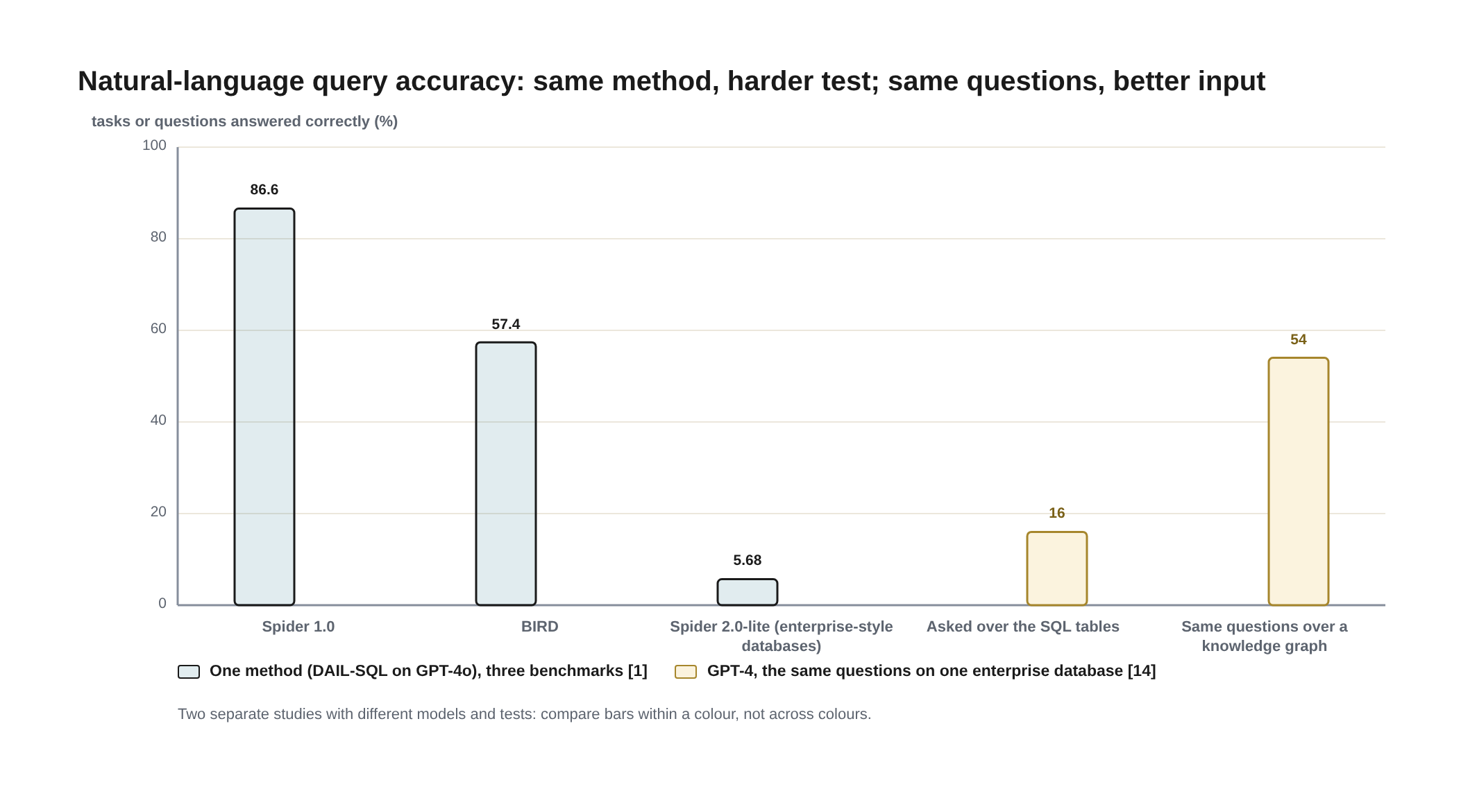
Natural-language query accuracy: same method, harder test; same questions, better input A bar chart; the vertical axis reads: tasks or questions answered correctly (%).
In one colour, One method (DAIL-SQL on GPT-4o), three benchmarks [1]: Spider 1.0, 86.6%; BIRD, 57.4%; Spider 2.0-lite (enterprise-style databases), 5.68%.
In a second colour, GPT-4, the same questions on one enterprise database [14]: Asked over the SQL tables, 16%; Same questions over a knowledge graph, 54%.
A note beneath the chart reads: Two separate studies with different models and tests: compare bars within a colour, not across colours.
These results show that what the model is given moves the answer. They do not say which input to fix first. My ranking is a judgement from practice, argued in Precise and Wrong: master data quality first, the semantic layer second. A knowledge graph is a kind of semantic layer, and it helped here. My claim is that a semantic layer over poor master data buys precision at the cost of accuracy: the wrong answer becomes exact and traceable, and a steward still has to fix the records. I have also said that AI will write semantic layers well before it can get a business to agree what they say. None of that is undone by a better model. A better model writes better SQL against the same records.
Gartner's forecasts point the same way, and they are forecasts, not counts. In February 2025 it predicted that "through 2026, organizations will abandon 60% of AI projects unsupported by AI-ready data", and reported that "Sixty-three percent of organizations either do not have or are unsure if they have the right data management practices" [15]. A year earlier it had predicted that at least 30% of generative AI projects would be abandoned after proof of concept by the end of 2025, naming "poor data quality" first among the reasons, alongside risk controls, costs and unclear value [16]. That is the demonstration that never became a system, counted from the outside.
And when a question box answers from bad or ungoverned data, the business owns the answer. In 2024 a British Columbia tribunal heard that Air Canada's website chatbot had told a grieving customer he could apply for a bereavement fare after travelling, which its own policy did not allow. Air Canada argued, in the tribunal's words, that "the chatbot is a separate legal entity that is responsible for its own actions"; the tribunal called this "a remarkable submission", found negligent misrepresentation, and ordered the airline to pay [2]. The amount was small. The principle is not: a natural-language interface speaks for the company, and garbage it is fed comes out in the company's voice.
What the model cannot do, and what it does brilliantly
The second thing true instead of the myth is a limit and a strength in one answer:
What AI cannot now, nor is likely ever to do very well, is gather requirements and make connections between disparate domains of knowledge. Once you’ve established the connection, AI can research like nothing else, but you need to keep a watch on it lest it imagine its way into a proof of Fermat’s Last Theorem being 1 = 1.
The limit first. Gathering requirements is not reading a document. It is the work of finding out what a business actually needs when the people asking do not agree, do not know, or are asking for the wrong thing, and deciding which of their definitions will hold. A model can draft a definition of an active customer in seconds; it cannot get sales and finance to accept the same one, which is why I expect AI to write the semantic layer well before it can deliver the agreement behind it. One benchmark I found tests a model interviewing a simulated user across 101 website scenarios. Its authors report that current models "elicit less than half of the users' implicit requirements", and that the bottleneck in automated software work "is shifting from generating correct code" to eliciting what users need [17]. It tests one simulated user, not getting sales and finance to agree on a definition. What would show this column shrinking is observable: scores on benchmarks like that one rising toward full recall of what users leave unsaid, or a model getting two departments to sign the same definition without a person brokering it. On that benchmark's numbers [17] the first is far off; for the second I found no measurement, so that part of my answer stays judgement.
The strength is real, and so is the warning, and one recent episode shows both. In October 2025 an OpenAI executive posted that GPT-5 had "found solutions to 10 (!) previously unsolved Erdős problems", a set of open problems in mathematics [18]. Thomas Bloom, who maintains the website listing them, called the claim "a dramatic misrepresentation": the problems were marked open on his site only because he did not know of a solution, and "GPT-5 found references, which solved these problems, that I personally was unaware of" [18]. Google DeepMind's chief executive replied: "This is embarrassing" [18]. Read carefully, the model did exactly what I said it does well. It searched a vast literature and found papers an expert had missed, which is a valuable piece of research. The people around it then imagined their way to a discovery that had not happened. The watching has to be done on the humans' claims as well as the model's.
The model's own claims need it too. OpenAI's researchers wrote in September 2025 that "standard training and evaluation procedures reward guessing over acknowledging uncertainty" [19]. In their own example on a set of short factual questions, an older model that almost never declined to answer got 75% of the questions wrong, while a newer one that declined about half the time got 26% wrong [19]. A question box tuned to always answer is tuned to guess. The courts have seen where that ends. In 2023 a federal judge in New York sanctioned lawyers who had "submitted non-existent judicial opinions with fake quotes and citations created by the artificial intelligence tool ChatGPT", observing that "A fake opinion is not 'existing law'" [20].
Two findings cut against the "never" in my answer, and they belong here. In July 2025 Google DeepMind reported that a version of its Gemini model "solved five out of the six" problems at the International Mathematical Olympiad, earning a gold-medal score, working in natural language within the competition's time limit [21]. That is reasoning, not lookup. But olympiad problems are set by people, and each comes with a known answer and a precise statement; nobody had to find out what the question was. That is the part I said a model does not do. The other finding is about speed. METR's 2025 trial found that experienced open-source developers took "19% longer" with AI tools than without, while believing the tools had sped them up [22]. In February 2026 METR reported, from a follow-up that kept 10 of the original developers and added 47 new ones, that developers using later tools were probably faster, while calling its data "only very weak evidence for the size of this increase" [23]. Both results support watching the tool and measuring it, rather than either myth: the one that it does nothing, and the one that it does everything.
Where the water runs first
My answer ended with a prediction about which industries AI will change:
AI will revolutionize industries that rely on generating and testing lots of code, but will do almost nothing to industries that rely on building tangible things in the real world or developing new concepts and ideas.
I closed by calling it my opinion, and when the second half was challenged, I said what kind of opinion it was:
If anyone chooses to take issue with my hyperbole, I'm being intentionally extreme. AI will affect everything, but, like most things, it will be scaled and will flow like water across Business seeking the low points and 'easy wins' first.
That is the position I will defend, and the evidence says the exaggeration needed taking back. The first half of the prediction I stand by: industries whose product is code, and whose output can be checked by running it, are where the change is fastest, because a model's mistakes there can be caught and corrected cheaply and at volume. "Almost nothing" was the deliberate overstatement. In 2024 the Nobel Prize in Chemistry went to David Baker "for computational protein design" and to Demis Hassabis and John Jumper "for protein structure prediction", the work behind AlphaFold [24]. Proteins are about as tangible as things get, and that work has changed how biology designs and develops new ideas. Google DeepMind has also reported finding "2.2 million new crystals" with a deep-learning model, of which outside laboratories had independently created 736 [25].
Even here the evidence is not one-sided. Anthony Cheetham and Ram Seshadri, two materials chemists, examined the claims of that work and reported "scant evidence for compounds that fulfill the trifecta of novelty, credibility, and utility", concluding that "there is clearly a great need to incorporate domain expertise in materials synthesis and crystallography" [26]. In both, people framed the problem; in the protein work, decades of carefully curated experimental structures, which scientists had spent half a century measuring and checking, did much of the rest. That is garbage in, garbage out running the other way. Good data in, Nobel-grade results out.
So the water image is the better claim, and it says where the low points are. AI speeds up the search inside a problem that people have framed, in the physical sciences as well as in software; that search is the easy win, and it is where the water has run first. Where the output is code, the search is most of the job and the result can be tested by running it, so the whole job speeds up. Where the output has to be built, grown, certified and shipped, the search is a smaller share of the work, so the job as a whole changes more slowly, even when the search itself is transformed. That still rules something out: it predicts that a business which builds physical things will not see its whole cycle from design to delivery compressed the way software delivery is being compressed, however good its models get at design. If that compression shows up in manufacturing or construction at scale, the narrower claim is wrong too.
What the believers paid
Asked what the myth had cost a business that believed it, I did not reach for a client's story, and I will not tell one. I answered for the whole class of early adopters:
It costs business the same thing it costs all early adopters: time and money. Operating on mistaken assumptions or beliefs about the efficacy or applicability of a new technology is always a risk. The thing that decides most often between winners and losers is the ability to change course and adapt to the realities of the technology rather than trying to achieve gains that are illusory.
The public record bears that out, and it shows the deciding move too. These are other companies' cases, reported by others, not mine (Figure 3).
Commonwealth Bank of Australia cut 45 roles in its direct banking team after it introduced a voice bot on its customer enquiries line. In August 2025 it reversed the decision, saying its assessment "did not adequately consider all relevant business considerations and this error meant the roles were not redundant", and adding: "We have apologised to the employees concerned and acknowledge we should have been more thorough in our assessment of the roles required" [27]. The reversal came after "Union members had brought the dispute over the cuts before Australia's Fair Work Commission" [28]. Klarna, which said in 2024 that its assistant could do the work of hundreds of customer service agents, was reported a year later to be investing in human support again, with its chief executive saying "there will always be a human if you want" [29]; that case is set out in Heads Up. Air Canada paid the customer its chatbot misled, and paid in reputation for arguing that the chatbot was responsible for itself [2].
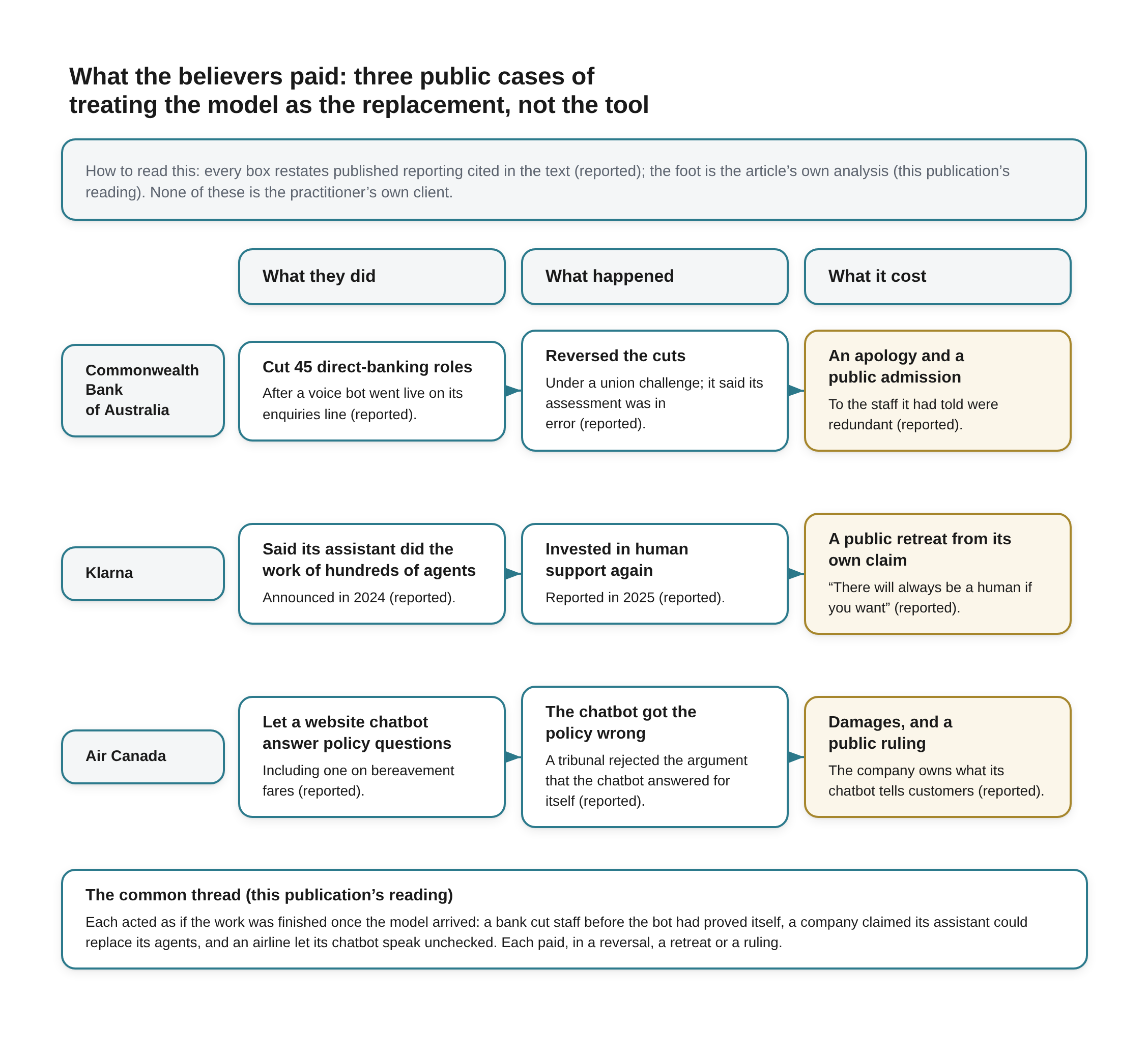
What the believers paid: three public cases of treating the model as the replacement, not the tool Beneath the title a key reads: How to read this: every box restates published reporting cited in the text (reported); the foot is the article’s own analysis (this publication’s reading). None of these is the practitioner’s own client.
Three column headings, left to right: What they did; What happened; What it cost. Three rows, one per company, each read left to right with arrows between the boxes.
Row Commonwealth Bank of Australia: Cut 45 direct-banking roles: After a voice bot went live on its enquiries line (reported). Reversed the cuts: Under a union challenge; it said its assessment was in error (reported). An apology and a public admission: To the staff it had told were redundant (reported). (The last box in the row is outlined in amber.)
Row Klarna: Said its assistant did the work of hundreds of agents: Announced in 2024 (reported). Invested in human support again: Reported in 2025 (reported). A public retreat from its own claim: “There will always be a human if you want” (reported). (The last box in the row is outlined in amber.)
Row Air Canada: Let a website chatbot answer policy questions: Including one on bereavement fares (reported). The chatbot got the policy wrong: A tribunal rejected the argument that the chatbot answered for itself (reported). Damages, and a public ruling: The company owns what its chatbot tells customers (reported). (The last box in the row is outlined in amber.)
Across the foot, a box headed The common thread (this publication’s reading): Each acted as if the work was finished once the model arrived: a bank cut staff before the bot had proved itself, a company claimed its assistant could replace its agents, and an airline let its chatbot speak unchecked. Each paid, in a reversal, a retreat or a ruling.
The larger and more often quoted figure needs a warning label. A report from MIT's Project NANDA in 2025 was widely reported as finding that "95% of organizations are seeing no business return" on generative AI [30]. Its own sample was 52 structured interviews, 153 survey responses and a review of over 300 public initiatives [30], and critics pointed out that it counted success only as "deployment beyond pilot phase with measurable KPIs" and leaned on "just 52 interviews" [31]. The number is not reliable enough to repeat as a measurement. What it does show is how readily the market believes that pilots fail, which, after the forecasts above, is not surprising.
The pattern across these cases is the one in my answer. Each business treated the model as the replacement rather than the tool: the bank removed the people before it knew what the bot could not do, the airline let the bot speak for it without governing what it said, and the funding demonstrations I have watched skipped the foundation and paid for it at scale. None of them paid because AI does not work. They paid because they believed the work was finished once the model arrived. What separated them afterwards was what they did next. The bank reversed itself under a union challenge and said why. Klarna changed course in public. Air Canada defended its chatbot as if it were someone else, and lost. The bank and Klarna paid in time and money and changed course; that, more than the size of the original mistake, is what most often decides who comes out ahead.
Before you switch it on
Here is what I would tell an executive who has been sold the myth along with a question box:
- Count tasks, not jobs. Sort the work around your data into the three columns of Figure 1 before you sort the people. The left column is where the savings are real. The right column is where the system will fail without people.
- Fix the data before you buy the interface. A model answering over poor master data produces fluent, confident, wrong answers, and your company owns every one of them.
- Get the definitions agreed by people, not just written by a model. A model can draft every definition in your semantic layer. Only the business can make them binding.
- Watch it, and watch the people watching it. Reward the system for saying it does not know. Check any claim of discovery, by the model or about the model, before you repeat it.
- Do not cut first. If the bot is going to do the work, let it prove that before the people go. The bank in Figure 3 apologised for skipping that step.
I have predicted that AI will keep taking on more of the work wherever it does a good-enough job (The Primrose Path), so none of this is an argument that it will stay small. It is an argument about what kind of thing it is. A calculator in the hands of someone who does not understand the sum produces a wrong answer faster. A question box over data nobody has governed does the same, in plain English, to everyone in the company at once. It is a tool, and the businesses that do well with it will be the ones that never forgot that.
References
[1] Fangyu Lei, Jixuan Chen, Yuxiao Ye, Ruisheng Cao and others, "Spider 2.0: Evaluating Language Models on Real-World Enterprise Text-to-SQL Workflows," International Conference on Learning Representations (ICLR 2025); arXiv:2411.07763 (v2, 17 March 2025). The abstract, the introduction and Tables 3, 4 and 5 read 2026-10-28; the rest of the paper was not read. https://arxiv.org/abs/2411.07763
[2] Moffatt v. Air Canada, 2024 BCCRT 149, British Columbia Civil Resolution Tribunal, decision of 14 February 2024. Read in full 2026-10-28 on the tribunal's decisions site. https://decisions.civilresolutionbc.ca/crt/crtd/en/525448/1/document.do
[3] Andy Jassy, "Message from CEO Andy Jassy: Some thoughts on Generative AI," Amazon, 17 June 2025. Read in full 2026-10-28. https://www.aboutamazon.com/news/company-news/amazon-ceo-andy-jassy-on-generative-ai
[4] Challenger, Gray & Christmas, "Job Cut Announcement Report, July 2026," released 6 August 2026. Read 2026-10-28. Counts of announced cuts and the reasons employers give, not measured displacement. https://www.challengergray.com/wp-content/uploads/2026/08/Challenger-Report-July-2026.pdf
[5] Megan Cerullo, "AI emerges as a top cause of layoffs, accounting for 26% of April's job cuts," CBS News MoneyWatch, 7 May 2026. Read in full 2026-10-28. https://www.cbsnews.com/news/ai-layoffs-job-cuts-challenger-report-april-2026/
[6] Martha Gimbel, Molly Kinder, Joshua Kendall and Maddie Lee, "Evaluating the Impact of AI on the Labor Market: Current State of Affairs," The Budget Lab at Yale, 1 October 2025. Read in full 2026-10-28. https://budgetlab.yale.edu/research/evaluating-impact-ai-labor-market-current-state-affairs
[7] Daron Acemoglu, "The Simple Macroeconomics of AI," NBER Working Paper 32487, May 2024. The abstract read 2026-10-28; the full paper was not read. https://www.nber.org/papers/w32487
[8] World Economic Forum, "Future of Jobs Report 2025: 78 Million New Job Opportunities by 2030 but Urgent Upskilling Needed to Prepare Workforces," press release, 8 January 2025. The press release read 2026-10-28; the full report was not read. https://www.weforum.org/press/2025/01/future-of-jobs-report-2025-78-million-new-job-opportunities-by-2030-but-urgent-upskilling-needed-to-prepare-workforces/
[9] Kristalina Georgieva, "AI Will Transform the Global Economy. Let's Make Sure It Benefits Humanity," IMF Blog, 14 January 2024. Read in full 2026-10-28. https://www.imf.org/en/Blogs/Articles/2024/01/14/ai-will-transform-the-global-economy-lets-make-sure-it-benefits-humanity
[10] Jenny Arena, "“Hidden Figures” and Human Computers," Smithsonian Magazine (Air & Space blog), 13 April 2018. Read 2026-10-28. https://www.smithsonianmag.com/blogs/air-space-museum/2018/04/13/emhidden-figuresem-and-human-computers/
[11] Erik Brynjolfsson, Bharat Chandar and Ruyu Chen, "Canaries in the Coal Mine? Six Facts about the Recent Employment Effects of Artificial Intelligence," Stanford Digital Economy Lab, first published August 2025, revised 12 August 2026. The publication page read 2026-10-28; the full paper was not read. https://digitaleconomy.stanford.edu/publications/canaries-in-the-coal-mine/
[12] Jinyang Li, Binyuan Hui and others, "Can LLM Already Serve as A Database Interface? A BIg Bench for Large-Scale Database Grounded Text-to-SQLs," arXiv:2305.03111 (v3, 15 November 2023). The abstract read 2026-10-28; the full paper was not read. https://arxiv.org/abs/2305.03111
[13] BIRD-SQL leaderboard, bird-bench.github.io. Read 2026-10-28; the top test-set execution accuracy and the human result as displayed that day. https://bird-bench.github.io/
[14] Juan Sequeda, Dean Allemang and Bryon Jacob, "A Benchmark to Understand the Role of Knowledge Graphs on Large Language Model's Accuracy for Question Answering on Enterprise SQL Databases," arXiv:2311.07509, 13 November 2023. The abstract read 2026-10-28; the full paper was not read. The authors' employer, data.world, sells a knowledge-graph data catalogue. https://arxiv.org/abs/2311.07509
[15] Gartner, "Lack of AI-Ready Data Puts AI Projects at Risk," press release, 26 February 2025. Read in full 2026-10-28. Analyst forecast and survey, cited as the firm's. https://www.gartner.com/en/newsroom/press-releases/2025-02-26-lack-of-ai-ready-data-puts-ai-projects-at-risk
[16] Gartner, "Gartner Predicts 30% of Generative AI Projects Will Be Abandoned After Proof of Concept By End of 2025," press release, 29 July 2024. Read in full 2026-10-28. Analyst forecast, cited as the firm's prediction. https://www.gartner.com/en/newsroom/press-releases/2024-07-29-gartner-predicts-30-percent-of-generative-ai-projects-will-be-abandoned-after-proof-of-concept-by-end-of-2025
[17] Dongming Jin, Zhi Jin, Zheng Fang, Linyu Li, XiaoTian Yang, Yuanpeng He and Xiaohong Chen, "ReqElicitGym: An Evaluation Environment for Interview Competence in Conversational Requirements Elicitation," arXiv:2602.18306 (v1, 20 February 2026). The abstract read 2026-10-28; the full paper was not read. https://arxiv.org/abs/2602.18306
[18] Anthony Ha, "OpenAI's 'embarrassing' math," TechCrunch, 19 October 2025. Read in full 2026-10-28. https://techcrunch.com/2025/10/19/openais-embarrassing-math/
[19] OpenAI, "Why language models hallucinate," 5 September 2025 (the accompanying paper, Adam Tauman Kalai, Ofir Nachum, Santosh S. Vempala and Edwin Zhang, arXiv:2509.04664, was not read). The page read in full 2026-10-28. https://openai.com/index/why-language-models-hallucinate/
[20] Mata v. Avianca, Inc., No. 1:22-cv-01461 (PKC), United States District Court for the Southern District of New York, Opinion and Order on Sanctions, 22 June 2023. Read in full 2026-10-28. https://law.justia.com/cases/federal/district-courts/new-york/nysdce/1:2022cv01461/575368/54
[21] Google DeepMind, "Advanced version of Gemini with Deep Think officially achieves gold-medal standard at the International Mathematical Olympiad," 21 July 2025. Read in full 2026-10-28. https://deepmind.google/discover/blog/advanced-version-of-gemini-with-deep-think-officially-achieves-gold-medal-standard-at-the-international-mathematical-olympiad/
[22] METR, "Measuring the Impact of Early-2025 AI on Experienced Open-Source Developer Productivity," 10 July 2025. Read in full 2026-10-28. https://metr.org/blog/2025-07-10-early-2025-ai-experienced-os-dev-study/
[23] METR, "We are Changing our Developer Productivity Experiment Design," 24 February 2026. Read in full 2026-10-28. https://metr.org/blog/2026-02-24-uplift-update/
[24] The Nobel Prize in Chemistry 2024, summary, NobelPrize.org (The Royal Swedish Academy of Sciences), 9 October 2024. Read 2026-10-28. https://www.nobelprize.org/prizes/chemistry/2024/summary/
[25] Amil Merchant and Ekin Dogus Cubuk, "Millions of new materials discovered with deep learning," Google DeepMind, 29 November 2023 (the underlying paper in Nature was not read). Read in full 2026-10-28. https://deepmind.google/discover/blog/millions-of-new-materials-discovered-with-deep-learning/
[26] Anthony K. Cheetham and Ram Seshadri, "Artificial Intelligence Driving Materials Discovery? Perspective on the Article: Scaling Deep Learning for Materials Discovery," Chemistry of Materials 36(8), 2024, pp. 3490–3495. The abstract read 2026-10-28 on eScholarship; the full article was not read. https://escholarship.org/uc/item/9qx9t3kz
[27] Carla Mascarenhas, "Commonwealth Bank reverses AI chatbot job cuts, admits error," The Canberra Times, 21 August 2025 (updated 22 August 2025). Read in full 2026-10-28. https://www.canberratimes.com.au/story/9046323/commonwealth-bank-reverses-ai-chatbot-job-cuts-admits-error/
[28] Carter Pape, "Australia's CBA halts AI-driven layoffs amid union pressure," American Banker, 25 August 2025. Read 2026-10-28. https://www.americanbanker.com/news/australias-cba-halts-ai-driven-layoffs-amid-union-pressure
[29] Sherin Shibu, "Klarna CEO Reverses Course By Hiring More Humans, Not AI," Entrepreneur, 9 May 2025. Read in full 2026-10-28. Trade reporting of an interview the chief executive gave Bloomberg; the Bloomberg original was not read. https://www.entrepreneur.com/business-news/klarna-ceo-reverses-course-by-hiring-more-humans-not-ai/491396
[30] David Ramel, "MIT Report Finds Most AI Business Investments Fail, Reveals 'GenAI Divide'," Virtualization Review, 19 August 2025, reporting MIT Media Lab Project NANDA, "The GenAI Divide: State of AI in Business 2025". The article read in full 2026-10-28; the report itself was not read. https://virtualizationreview.com/articles/2025/08/19/mit-report-finds-most-ai-business-investments-fail-reveals-genai-divide.aspx
[31] Mike Kaput, "That Viral MIT Study Claiming 95% of AI Pilots Fail? Don't Believe the Hype," Marketing AI Institute, 26 August 2025. Read in full 2026-10-28. Commentary, cited for its critique of the study's method. https://www.marketingaiinstitute.com/blog/mit-study-ai-pilots
[32] Spider 2.0 leaderboard, spider2-sql.github.io. Read 2026-10-28; the top ranked Spider 2.0-Lite and Spider 2.0-Snow execution accuracies as displayed that day, the News entry of 2025-05-22 removing the original Spider 2.0 setting, and the 2025-01-10 notice that evaluation examples have been updated since the paper. https://spider2-sql.github.io/